THE SILENCE ABOVE
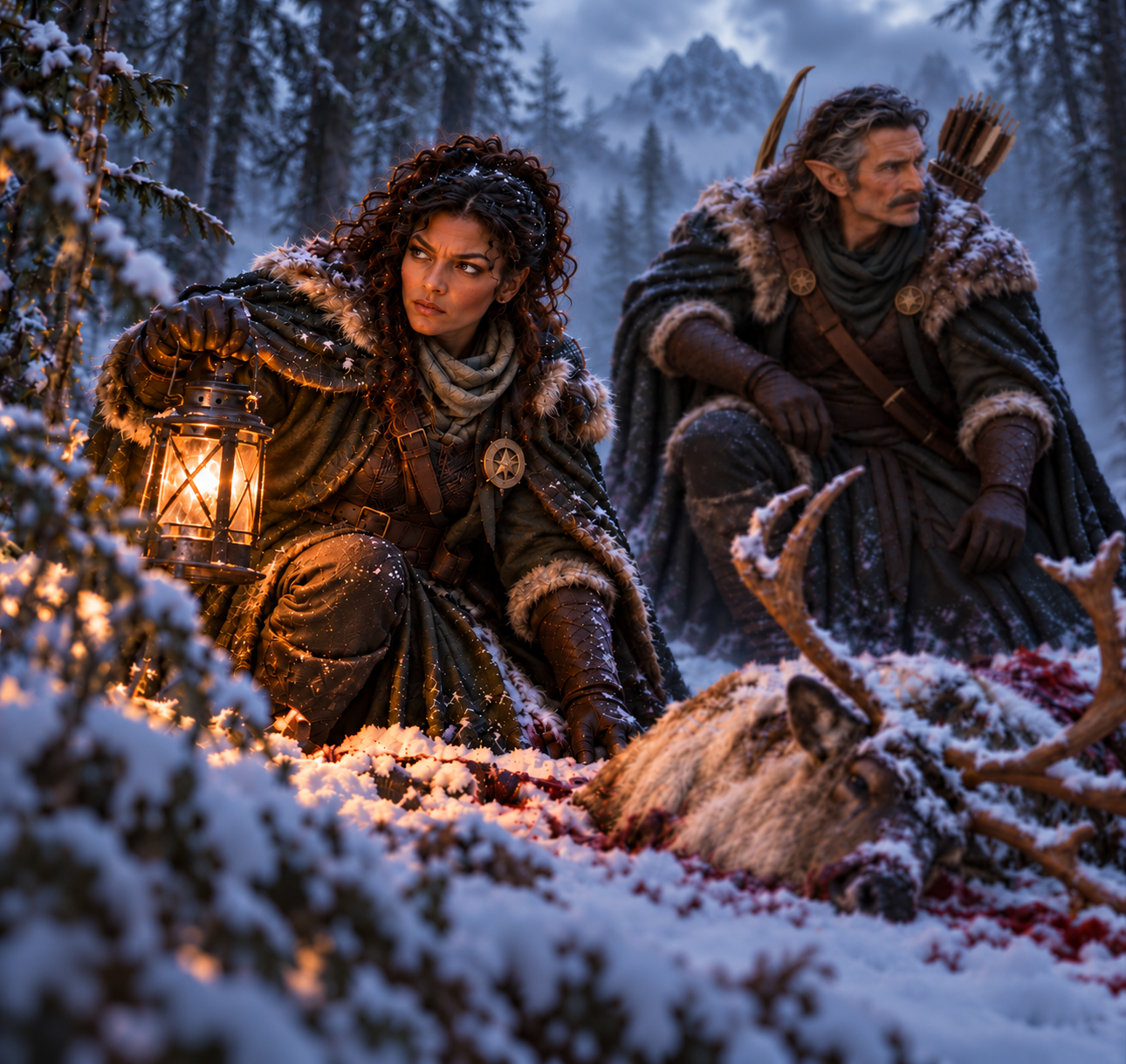
The first caribou was found before sunrise. By midday, there were nine, scattered across the upper pasture of the Dorran farm where the valley narrowed against the mountains and the evergreens crowded close beneath the snow. Underconstable Tessa Coldflame knew almost immediately that wolves had not done this. The animals had been opened rather than mauled, their throats cut wide and ribs exposed with a crude, unsettling precision. Almost no flesh was missing, and the snow showed little sign of panic. No churned ground, no long trails of fleeing animals, no broken fence. Old Merek Dorran insisted his wife had heard the herd during the night, but not screaming or running. One animal had called, then another, then another, until the pasture went silent. Tessa looked toward the forest and knew the answer would be there. She dispatched a deputy to bring Klifton.
Klifton joined her before noon and said little as he examined the pasture. He studied the carcasses, the fence, the snow, and then the trees. Near the eastern edge he found a shallow depression that looked less like a footprint than the mark of something heavy touching down only briefly. Above it, snow had been shaken from branches nearly twelve feet overhead, one limb cracked and another freshly scraped. From there he began following signs that Tessa would never have noticed alone: bent branches, stripped bark, patches of snow knocked loose from upper limbs despite the still air. They found coarse gray-white hair caught against a cedar, but Klifton could not identify it. As they moved deeper into the forest, the usual sounds faded away until there were no birds, no squirrels, no cracking wood, only the soft press of their own steps in the snow. Then a branch bowed ahead of them, sprang back, and another moved beyond it. Something was traveling through the trees without touching the ground.
Klifton had an arrow nocked before Tessa drew her sword. They watched the canopy as form moved from branch to branch, heavy enough to bend mature limbs yet careful enough to remain hidden. Then it stopped. The stillness that followed was worse than the movement. Tessa knew at once that whatever they were following had become aware of them.
They found the tenth caribou less than half an hour later, wedged high into the fork of a massive fir nearly twelve feet above the ground. It had not fallen there. Something had lifted it. Deep scratches marked the trunk beneath it, some narrow and penetrating, others broad enough to look more like gripping marks than claws. At the base of the tree lay three smooth pale river stones, though there was no open water this high in the valley. Tessa pocketed one. Klifton pried open the dead animal’s mouth with the tip of an arrow, and a strip of gray-white hide fell into the snow, matching the hair they had found earlier. It did not feel like something dropped by accident. It felt left for them.
By then they had learned how to read the creature’s passage through the forest. Snowless branches, fresh gouges, scattered needles, a young pine bent almost to the ground and snapped halfway up its trunk. The signs led them to a low rocky rise where the roots of an enormous fir clutched exposed stone. Beneath it was a shallow hollow that smelled of blood, rot, and wet fur. Inside, bones covered the ground: caribou, deer, foxes, a wolf. Some were old and clean, others fresh, but almost none had been eaten normally. Bodies had been opened, joints pulled apart, ribs separated, skulls cracked and left beside otherwise untouched remains. Tessa had seen the work of predators before. This was not feeding. Something had been examining them.
Near the rear of the hollow, four antlers had been arranged upright against the stone in two careful pairs. Between them rested another pale river stone, and beside it lay a frozen leather boot with part of a trouser leg still inside. When Tessa brushed away the snow she found part of a human leg and several finger bones, but nothing close to a complete body. The discovery changed the investigation at once. Dead livestock could still be explained as the work of some unknown beast. A human body could not.
A branch creaked outside.
Something moved beyond the hollow, and for a moment they saw it only in pieces: a pale limb curling around a trunk, gray fur shifting behind needles, something long folding itself across a branch high above the ground. It was almost animal, with a narrow muzzle, deep-set eyes, and antlers growing unevenly from the skull. It appeared to be made from several different creatures, yet there was something disturbingly familiar in the expression. It looked directly at Tessa before vanishing into the canopy.
Klifton fired.
The arrow disappeared into the branches, followed by a shriek that at first sounded like a wounded caribou. Then the sound changed, and the creature called Tessa’s name in Klifton’s voice. A few moments later, farther away, Tessa heard her own voice call for Klifton. Neither of them answered. They backed away from the hollow and did not turn fully from the forest until the Dorran farm appeared through the fog.
Tessa returned the next morning with six deputies and two hunters. They found the pasture, the damaged trees, and the place where the tenth caribou had been hung, but the hollow was empty. No bones, no boot, no antlers, no blood. Whatever had been there had moved everything during the night. Tessa kept the pale stone she had taken from beneath the tree and locked it in the evidence cabinet at the constable’s office without mentioning it in her written report.
By dawn, the cabinet stood open. The lock was untouched. The stone was gone, and wet pine needles covered the floor.
Then something moved across the roof. The wood beams of the ceiling protesting against the weight.
Slowly.
Deliberately.
Tessa reached for her sword and waited until the sound passed toward the chimney and faded away. Only then did she notice the object lying on her desk.
Klifton’s arrow.
The one he had fired into the creature.
The shaft had been snapped cleanly in half.
The arrowhead was missing.
Whatever lived in the upper forest had not merely survived.
It had followed her home.