The Fuzzy Dice
  • Home
  • ABOUT
  • Player Characters
  • NPCs of Embermist Hollow
  • Gallery
     
    The Fuzzy Dice
      • Home
      • ABOUT
      • Player Characters
      • NPCs of Embermist Hollow
      • Gallery

      Gallery


      • Album
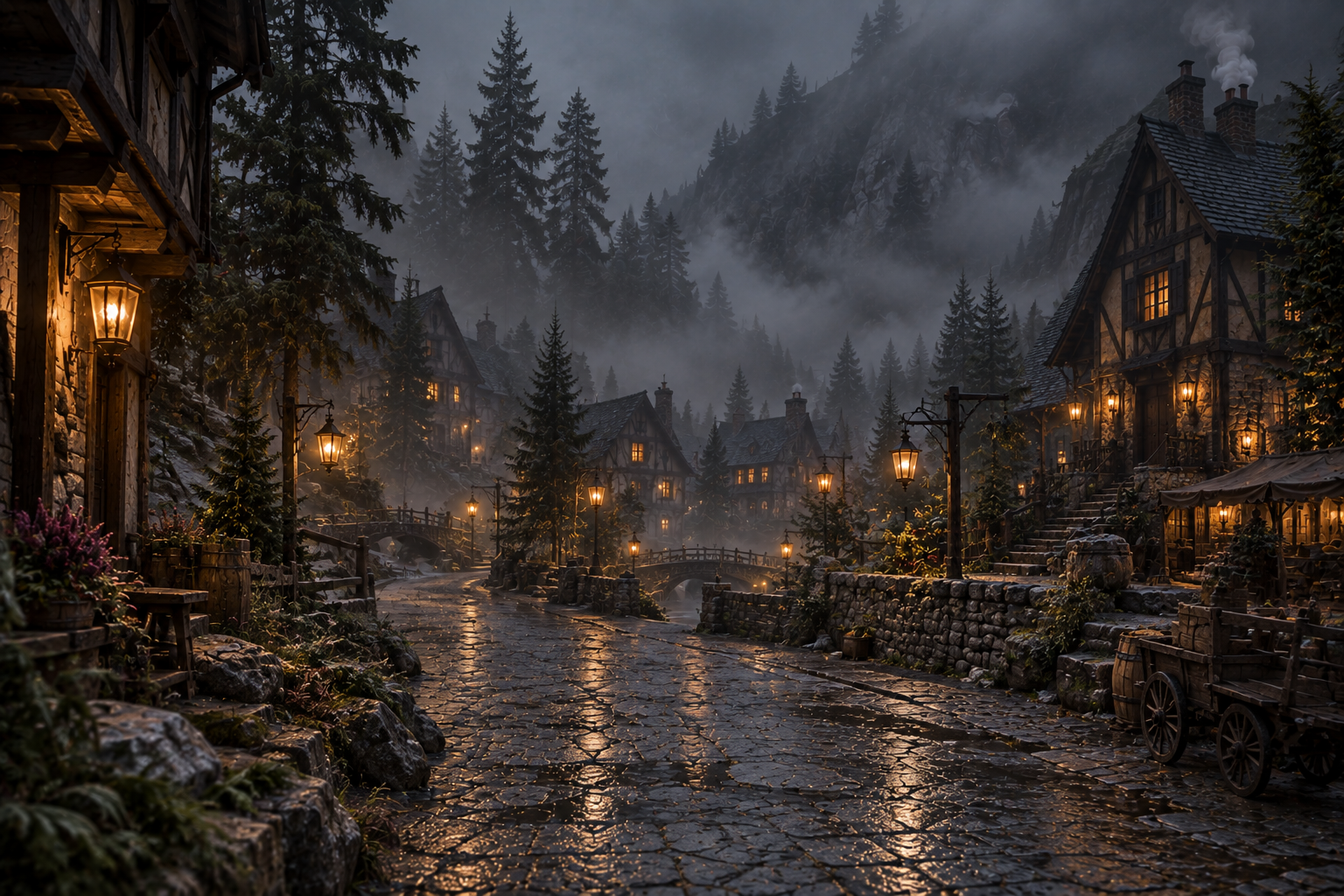
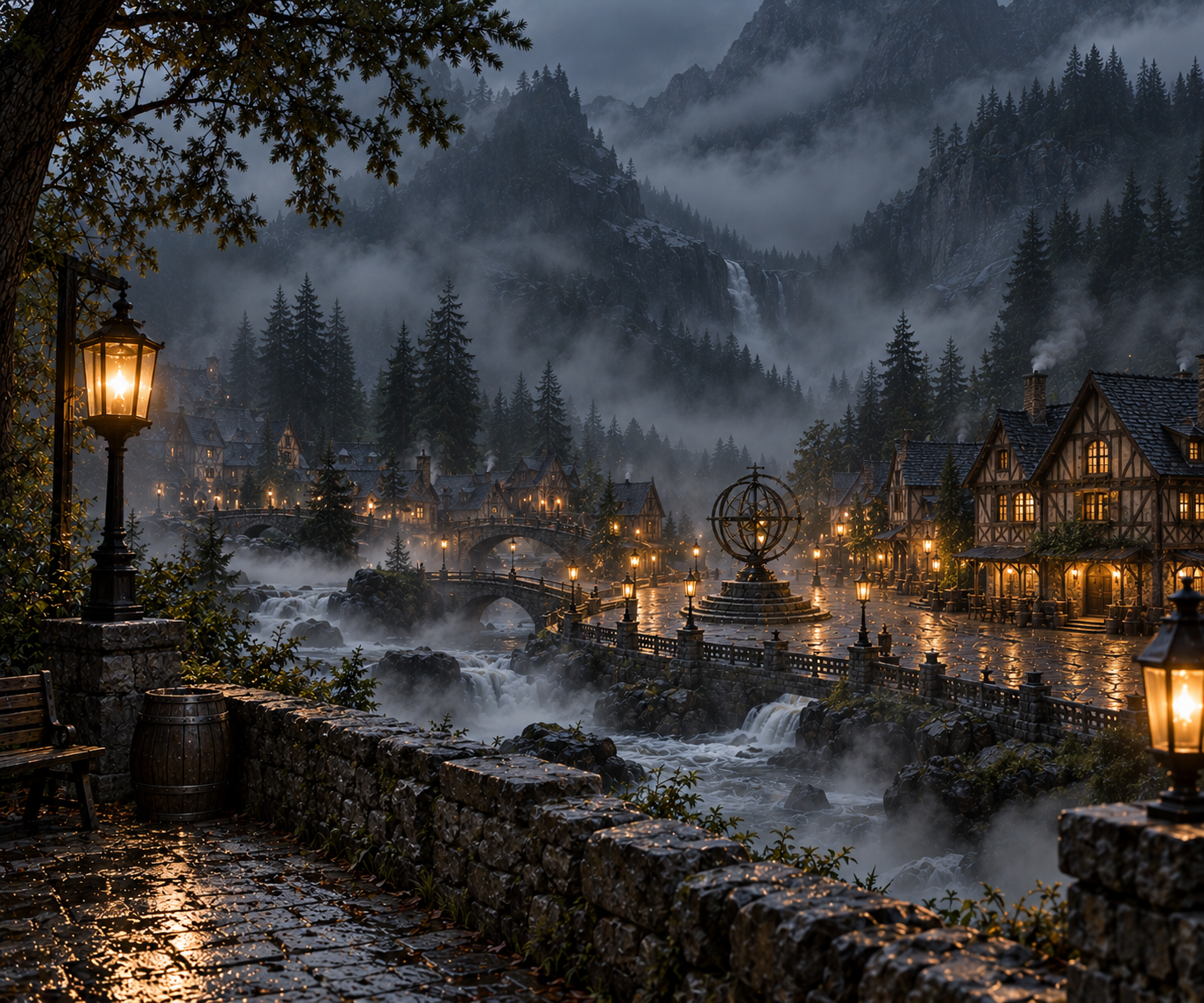
      EMBERMIST HOLLOW VILLAGE - Hidden deep within a narrow mountain valley, the village is a place of warm lanterns surrounded by seemingly endless gloom.

Sheer, pine-covered mountains rise on every side, their upper reaches frequently disappearing into cloud and fog. Waterfalls tumble from distant cliffs, feeding the network of cold mountain rivers and streams that wind directly through the settlement. Stone bridges connect neighborhoods divided by the water, while smaller wooden footbridges cross the narrow branches.

The village is beautiful.

But there is something undeniably strange about it.

A thick blanket of mist and low cloud settles over the valley for much of the year. Even during daylight, the sun is often little more than a pale glow somewhere above the mountains.

The village has adapted to living without reliable sunlight.

Lanterns are everywhere.

They hang from buildings, stand beside bridges, illuminate intersections, mark forest paths, and burn outside isolated homes. Their warm amber glow has become such an essential part of village life that the people barely notice them anymore.

Keeping those lights burning is the responsibility of Cornelia, Cornwalis, and the Lamplighter Guild.

To outsiders, the number of lanterns can seem excessive.

Villagers know better.

Around here, light means safety.

Most buildings are constructed in an old Tudor style of dark timber, rough stone, plaster, and steep slate roofs designed to withstand the mountain weather. Nothing is particularly grand. Buildings usually rise two stories, and even the wealthier homes retain the practical character of a settlement isolated deep within the mountains.

Cobblestone streets twist organically between homes rather than following any deliberate plan. Moss grows between the stones. Ivy climbs walls. Pine trees and enormous boulders have often been incorporated into neighborhoods rather than removed.

The village feels as though it was built around the valley rather than imposed upon it.

At its heart is the Central Plaza, where merchants gather with their carts and stalls. Shops, homes, guildhouses, and workshops surround the square, and nearby stands one of the village's strangest landmarks: The Astrolabe.

Its intricate rings slowly turn above the plaza, covered with strange markings whose original purpose few villagers understand. Once each year during the Lantern Festival, it releases a pulse of magic that drives the fog from the valley and reveals the stars overhead.

For many villagers, it is the only truly clear night sky they see all year.

Not far from the Astrolabe stands the Wrong Turn Tavern & Inn, the true social center of the village.

Its windows glow late into the night, and laughter can often be heard before the building itself emerges from the fog.

Everyone eventually passes through the Wrong Turn.

Farmers drink beside merchants. Rennin's deputies share tables with adventurers. Travelers bring news from outside the valley. Deals are made, arguments begin, romances flourish, and rumors spread with astonishing speed.

If the Central Plaza is the village's heart during the day, the Wrong Turn becomes its heart after dark.

Water is everywhere.

Heated by underground volcanic activity, the main river winds past the center of town, its banks lined with homes, workshops, docks, and warehouses. Smaller branches divide from it and wander through neighborhoods before eventually rejoining downstream.

Near the edge of town stands Miller's Folly, its enormous waterwheel turning relentlessly in the current.

Above the main river sits the Riverwatch, an old stone overlook where villagers gather beneath lanterns to watch the water and look across the rooftops toward the Astrolabe and the glowing windows of the Wrong Turn.

The village becomes quieter toward its edges.

Here stand places such as Stone and Root, Brynhild's welcoming home and herbal shop, and the Broken Compass, whose shelves contain nearly everything a traveler might reasonably need—and several things nobody remembers ordering.

Rennin maintains order from the Constable's Office, while Cornelia and Cornwalis operate from the deceptively ordinary headquarters of the Lamplighter Guild.

In the wealthier quarter stand larger homes behind low stone walls, including the ancestral manor belonging to Ilianna's family.

Then there is the Cold Forge.

Its doors remain closed.

Its windows remain dark.

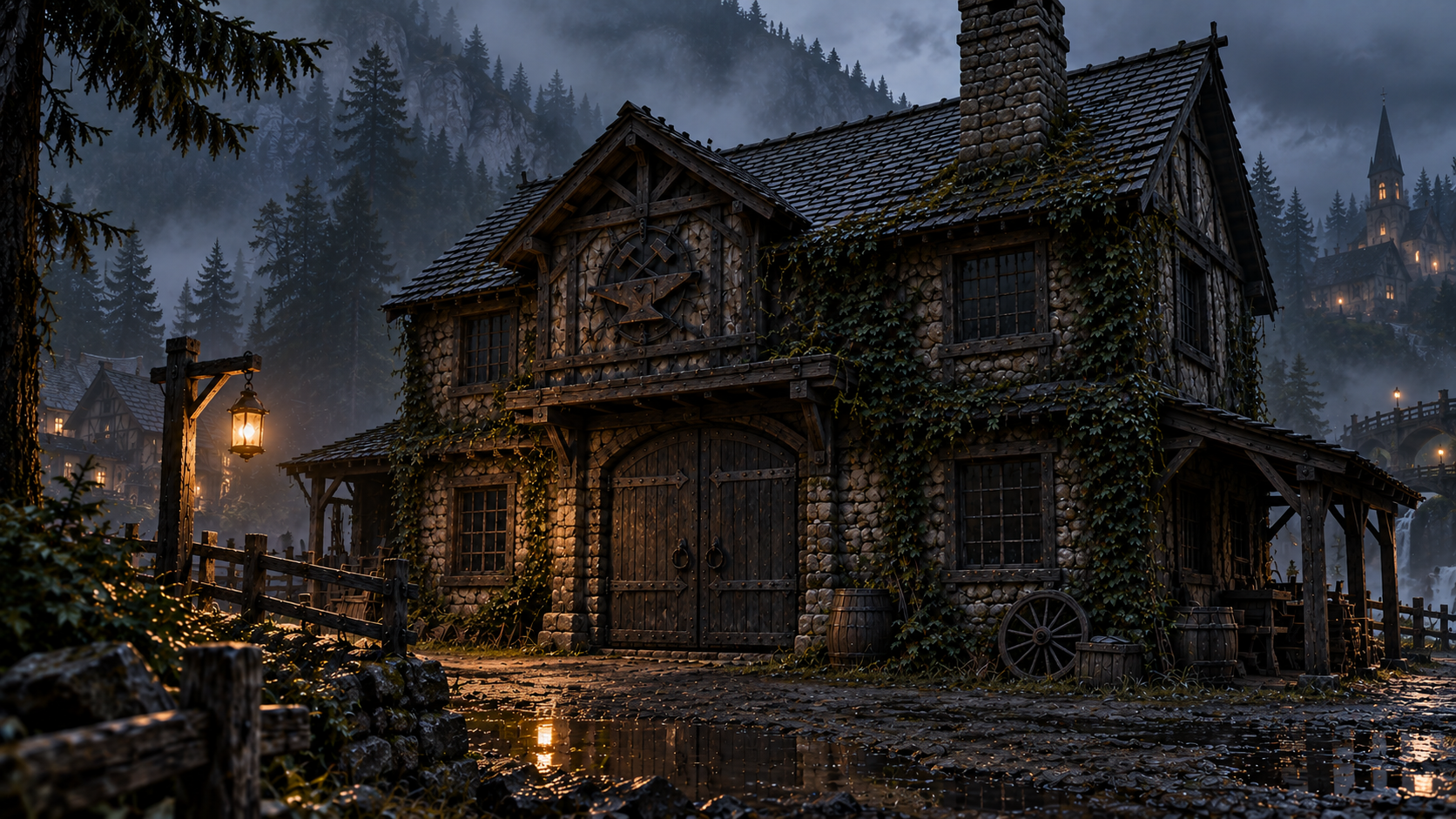
The vegetation has slowly begun reclaiming the old weaponsmith's workshop.

Nobody works there anymore.

Sometimes people hear hammering anyway.

Eventually the cobblestones surrender to forest.

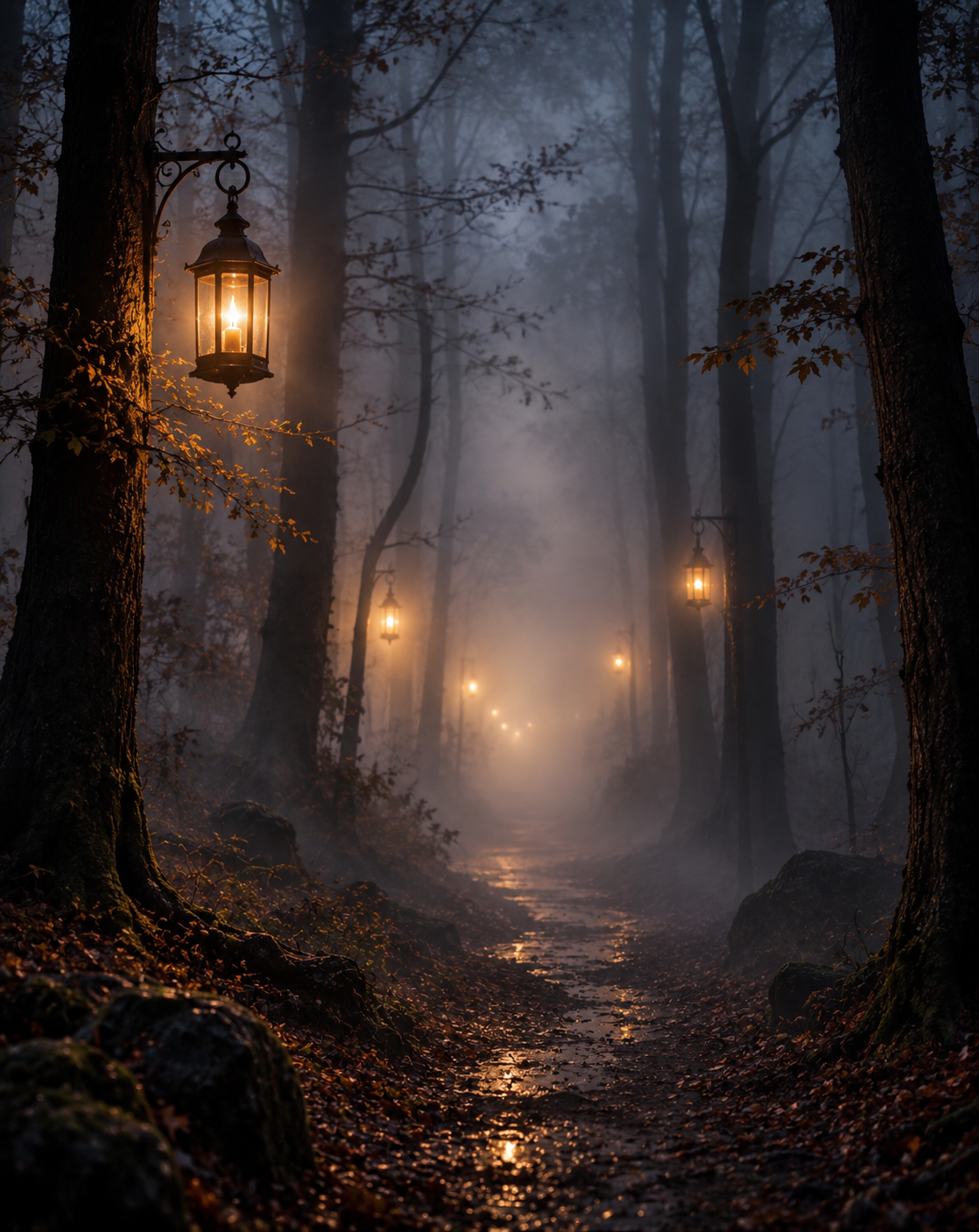
One road becomes the Emberway, disappearing beneath towering pines with lanterns marking its route through the fog.

Another path leads toward the Stillgarden, the village's old cemetery and mausoleum. Beneath the mausoleum lie ancient crypts and natural caverns extending much farther beneath the valley than most villagers realize.

And one path climbs.

Higher and higher into the mountains it winds until reaching the Meeting House, where the reclusive elven warrior-monks receive outsiders.

Villagers are permitted to travel that far.

No farther.

Beyond the Meeting House, the path continues upward toward the forbidden monastery hidden somewhere among the cliffs and fog.

For all its mysteries, the village isn't a grim place.

Quite the opposite.

People have learned to compensate for the darkness by making their homes warm, colorful, noisy, and communal.

Neighbors know one another. Shopkeepers remember customers. Doors remain open to friends. People gather around fireplaces and share meals because spending too much time alone in a place surrounded by fog and mountains doesn't appeal to anyone.

There are festivals, markets, music, gossip, arguments, romances, rivalries, and traditions stretching back generations.

People complain about Rennin.

Rennin complains about paperwork.

Everyone complains about the Burgomaster.

And Cornelia and Cornwalis somehow know about all of it.

At sunset, the village changes.

The mountains become enormous black silhouettes.

Fog rolls much thicker through the streets and across the rivers.

Doors close.

Shutters are drawn.

Then, the purpose of the commonplace lanterns become more apparent.

Across bridges.

Along streets.

Beside homes.

Through the Central Plaza.

Up the Emberway.

From the mountains above, the entire village looks like a constellation of tiny golden stars trapped beneath an ocean of fog.
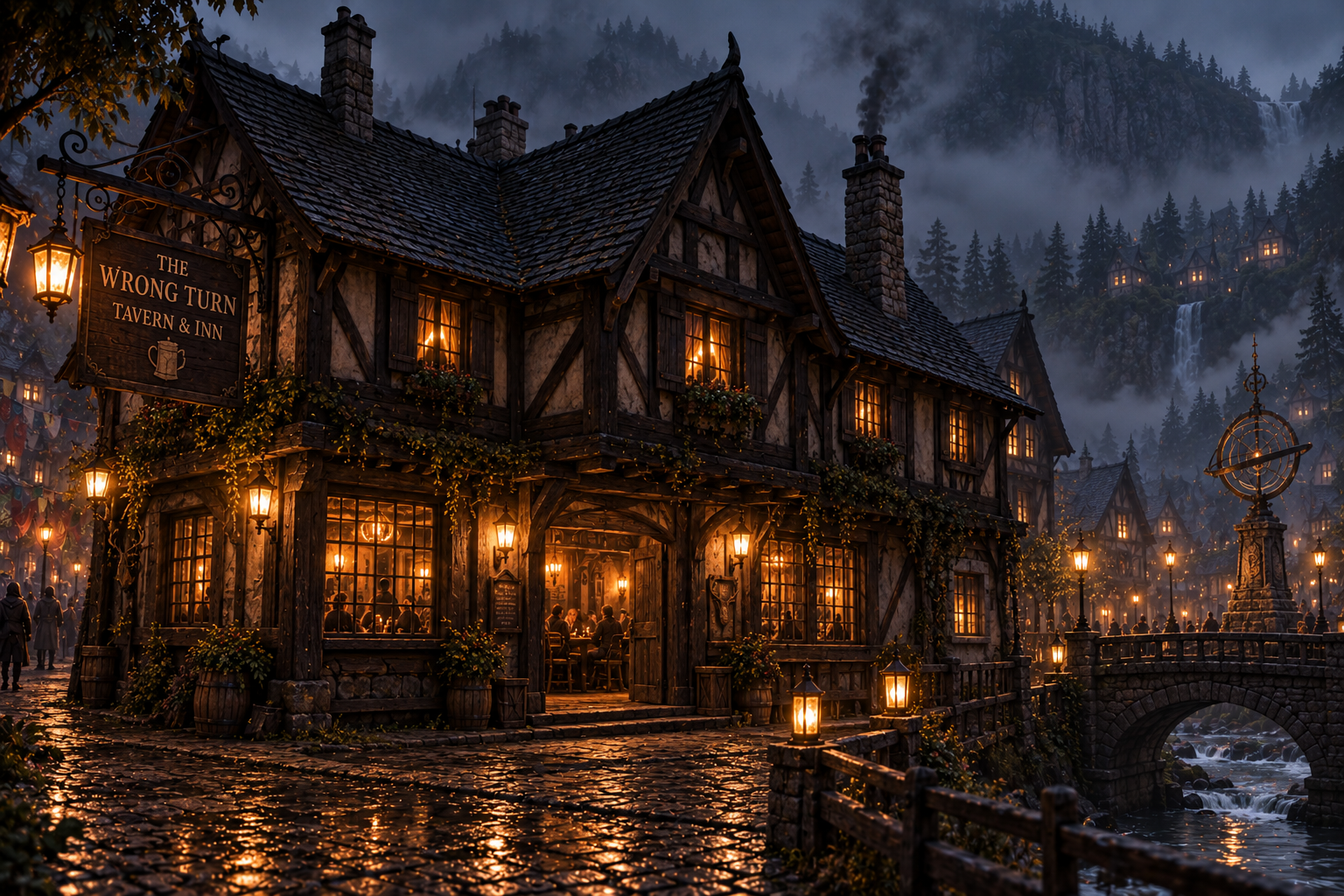
      THE WRONG TURN - The Wrong Turn is the beating heart of the village.

Standing beside the main branch of the river near the Central Plaza, the large two-story Tudor tavern and inn is one of the first places newcomers notice and one of the last places still awake at night. Its dark timber frame, rough stone foundation, steep slate roofs, and tall chimneys give it the appearance of a building that has stood here for generations. A large wooden sign hangs beside the entrance:

THE WRONG TURN — TAVERN & INN

The name comes from an old local saying that anyone who found this isolated village must have taken a wrong turn somewhere.

At almost any hour, the Wrong Turn glows.

Lanterns hang beneath the eaves and beside the doors, while large ground-floor windows spill golden light across the wet cobblestones. Smoke curls constantly from the chimneys. On cold evenings, opening the front door releases a wave of warmth accompanied by the smells of woodsmoke, roasting meat, fresh bread, spilled ale, and pipe tobacco.

And then comes the noise.

Conversation. Laughter. Tankards striking tables. Chairs scraping floors. Someone arguing over cards. Someone else telling a story everyone has heard twenty times. Occasionally music rises above everything before being drowned out again by the crowd.

The Wrong Turn is rarely quiet.

Most of the ground floor is dominated by an enormous common room, built around a great stone hearth that burns almost continuously.

Long wooden tables encourage strangers to sit together, while smaller tables occupy the walls and windows. A broad, battered bar stretches across one side of the room, its shelves crowded with bottles, mugs, jars, and casks.

Nothing matches perfectly.

The chairs have been repaired dozens of times. Tables bear knife marks and initials. The floorboards creak. The stone around the hearth has been blackened by decades of fires.

It feels comfortable rather than shabby.

There are always familiar faces here. Merchants conduct business over drinks. Farmers stop after delivering goods. Lamplighters gather after their evening rounds. Rennin's deputies occasionally occupy a corner table. Adventurers attract curious glances until they've been around long enough to become part of the scenery.

Even Cornelia and Cornwalis appear with suspicious frequency.

The second floor is much quieter.

A broad staircase leads to a hallway containing a dozen modest guest rooms. Their small mullioned windows are the warm squares of light visible from the street at night.

The rooms aren't luxurious, but they're comfortable: heavy wooden beds, thick quilts, washbasins, wardrobes, small writing tables, and lanterns beside the beds. A few larger rooms overlook the river and command surprisingly beautiful views of the village.

From one side, guests can see the Central Plaza and Astrolabe through the fog.

From the other, they can fall asleep listening to the river.

Assuming the noise downstairs doesn't keep them awake.

The Wrong Turn serves a purpose far greater than providing food and beds.

It is effectively the village's communal living room.

Birthdays are celebrated here. Deals are struck here. Arguments begin here—and occasionally end outside. Travelers bring news from beyond the valley. Adventurers find work. Villagers gather when storms close the mountain roads.

When something frightening happens, people instinctively gravitate toward the Wrong Turn.

There is warmth.

There is food.

There are other people.

And there are always lanterns burning.

During the Lantern Festival, the tavern becomes almost impossibly crowded. Every room is occupied, tables spill into every available corner, musicians play until late into the night, and people stand shoulder-to-shoulder around the bar.

From its windows, the Astrolabe can be seen across the plaza.

And when its annual pulse drives away the fog and reveals the stars, practically everyone inside pours into the street at once.

There is an old custom at the Wrong Turn:

Nobody drinks alone unless they want to.

A stranger sitting by themselves long enough will eventually find another mug placed on their table and somebody pulling up a chair.

That, more than the ale or the rooms, explains why the Wrong Turn has endured.

Outside its windows lies a village of fog, secrets, dark forests, strange magic, and things moving beyond the lantern light.

But inside the Wrong Turn there is fire, laughter, food, friendship, and noise.

For a few hours, at least, the gloom stays outside.
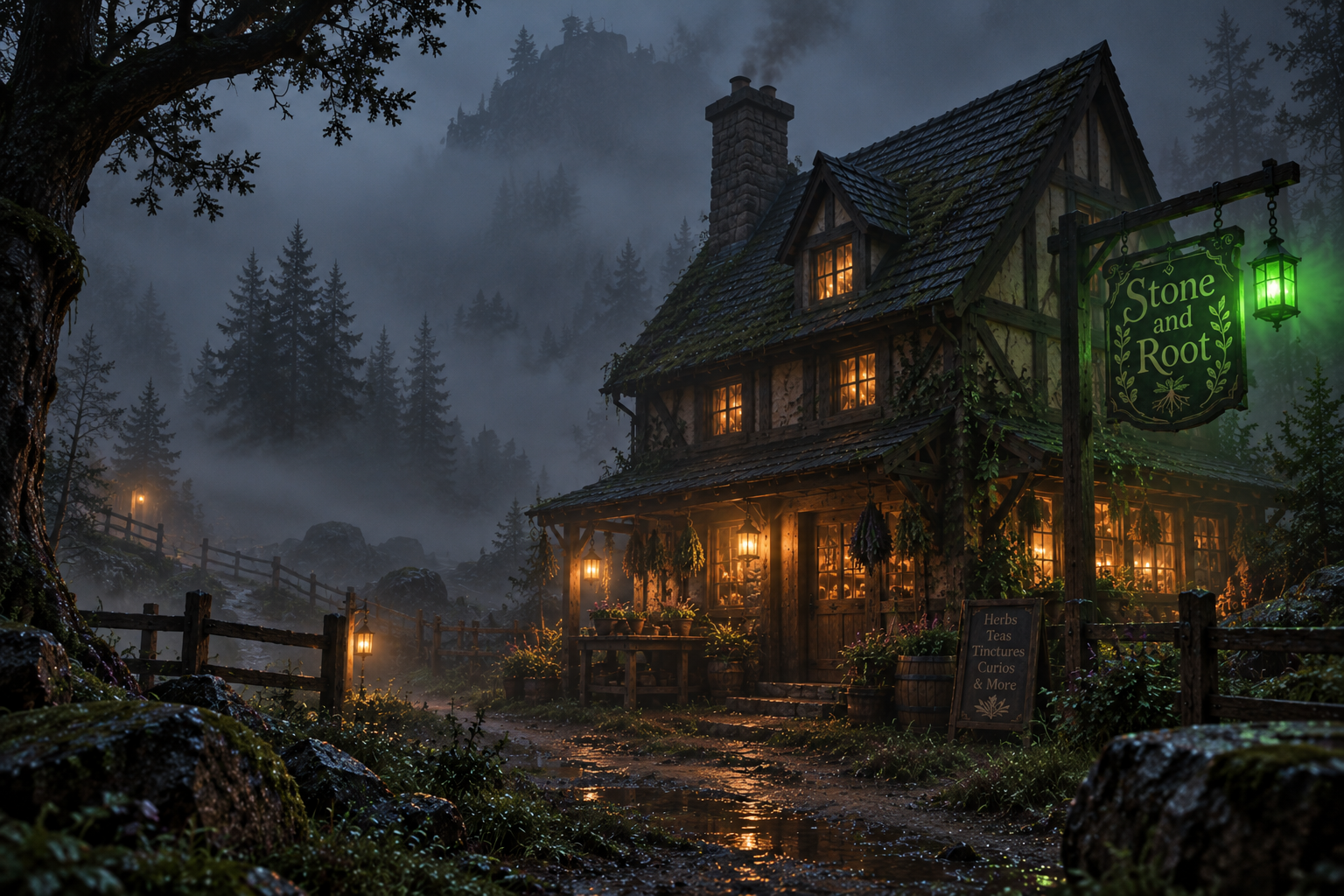
      STONE AND ROOT - Inside, the gloom of the village seems to disappear.  The shop is comfortably cluttered with shelves of herbs, dried mushrooms, roots, teas, tinctures, salves, candles, and bundles of medicinal plants. Dried flowers and herbs hang from the ceiling beams, while little handwritten labels cover jars and ceramic pots. There is always something simmering over the hearth—a kettle of tea, a medicinal broth, or occasionally Brynhild's dinner. The air smells of cedar smoke, lavender, dried mint, damp earth, and fresh bread.

But Stone and Root is also Brynhild's home, and she makes little distinction between the two. Beyond the counter sits a large scarred wooden table surrounded by mismatched chairs. Friends know they don't need an invitation to sit down. Customers who arrive cold or frightened frequently discover that a cup of hot tea has appeared in their hands before they've even explained why they've come.

There are comfortable chairs near the hearth, blankets folded in a basket, books stacked wherever there is room, and an old kettle that seems permanently suspended over the fire. Brynhild keeps food in the cupboard specifically because she knows certain people will inevitably arrive hungry.

There is no formal closing time. If the viridian lantern outside the shop is burning, Brynhild is awake—and anyone she considers a friend is welcome.

Among the villagers, Stone and Root has quietly become neutral ground. Guards, thieves, adventurers, merchants, lamplighters, and ordinary villagers have all found themselves sitting around Brynhild's table at one time or another. Arguments have a peculiar tendency to become quieter once tea is poured.

Brynhild herself would never call the place a sanctuary.

But that's what it is.

Stone and Root is where people in the foggy village go when they need medicine, advice, warmth—or simply somewhere they know they'll be welcome.

“There’s one candle in Stone & Root that Brynhild never sells, never moves, and never lets go out. We’ve stopped asking why.”
— Cornelia & Cornwalis
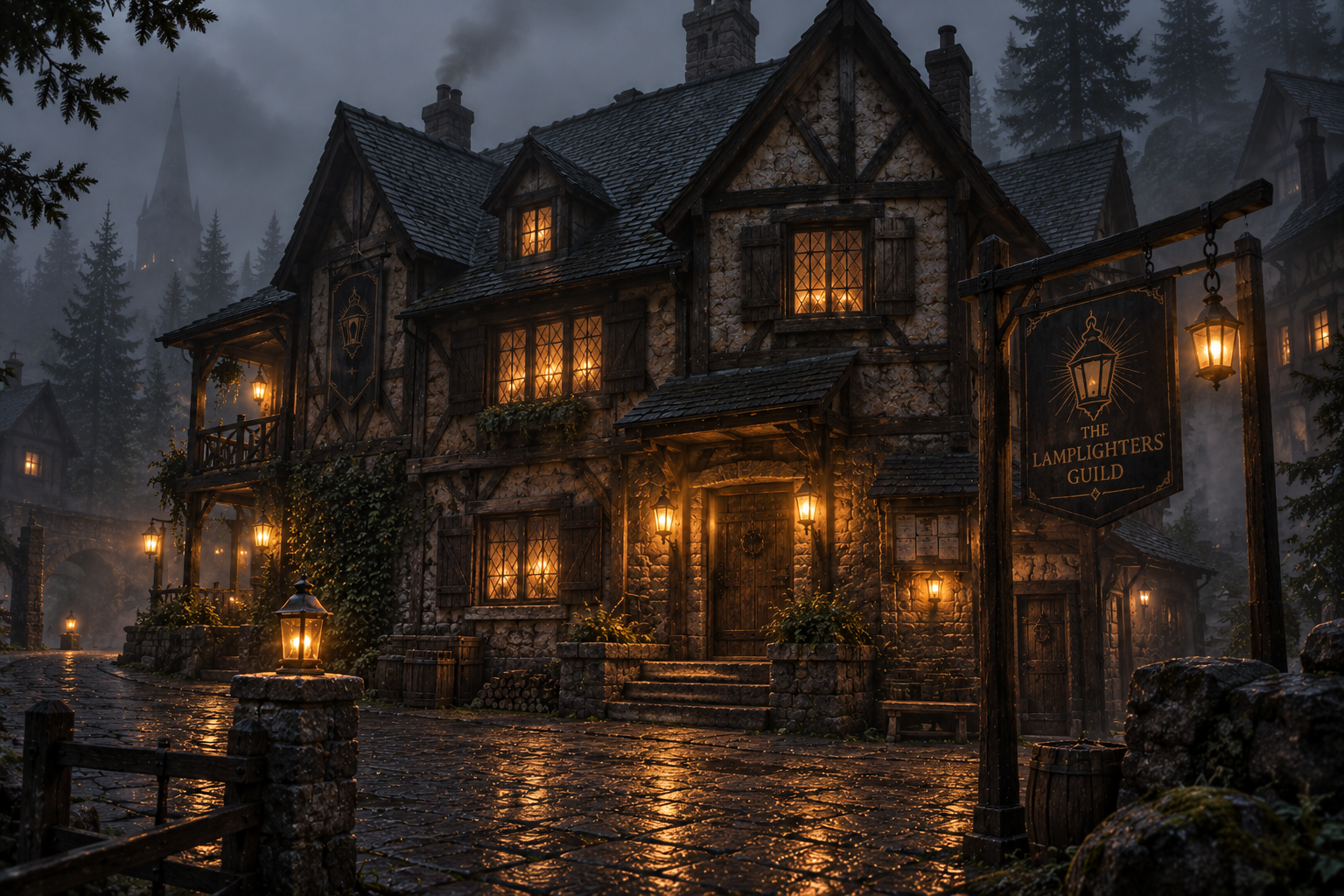
      THE LAMPLIGHTER GUILD - The Lamplighter Guild Headquarters is surprisingly unremarkable for an organization that seems to know nearly everything happening in the village. It occupies a broad, comfortable two-story home on a quiet cobblestone lane, marked only by a small wooden sign bearing the image of a burning lantern. There are no grand banners or official proclamations. If you didn't know what you were looking for, you might mistake it for the home of a prosperous merchant.

One thing, however, immediately distinguishes it: the lanterns never go out.

Day or night, fog or storm, several lanterns burn outside the headquarters. Their warm amber light spills across the wet stones and pushes back the perpetual gloom. Inside, the place feels more like a crowded family home than a guildhall. A large hearth burns constantly, kettles simmer, boots dry beside the fire, and the long central table is usually buried beneath maps, repair ledgers, lamp oil receipts, half-eaten meals, mugs of tea—and scraps of paper containing information that probably shouldn't be there.

The guild is run by the halfling siblings Cornelia and Cornwalis, a cheerful, mischievous pair whose harmless appearance has fooled more than one newcomer. Officially, they oversee the village lanterns, organize nightly lighting routes, replace damaged lamps, maintain oil supplies, and ensure that no important street is ever surrendered completely to the fog.

Unofficially, they seem to know everyone's business.

Lamplighters go everywhere. They climb past bedroom windows, work behind taverns, wander empty streets after midnight, enter businesses before dawn, and hear conversations from people who forget that the little figure on the ladder nearby has ears. Every evening dozens of guild members leave headquarters carrying ladders, oil, tinderboxes, and replacement glass. Every morning they return with considerably more information than they left with.

Cornelia and Cornwalis insist this is coincidence.

Ask Cornelia about a secret meeting behind the Wrong Turn Tavern and she'll look genuinely surprised that you'd imagine she knew anything about it—while casually mentioning what time the participants left. Cornwalis might deny knowing who's sleeping with whom while reminding you that someone's husband unexpectedly returned home at half past midnight last Thursday.

Neither sibling considers this spying.

"We maintain lanterns."

That's usually where the explanation ends.

Despite their questionable respect for privacy, the Lamplighters are fiercely protective of the village. They understand better than most that the lanterns aren't merely decoration. Light means safety. When the fog thickens, something prowls the streets, or strange magic settles over the valley, the guild doubles its patrols without needing to be asked.

And when something truly dangerous is happening, Cornelia and Cornwalis somehow seem to appear nearby—usually carrying a ladder, an oil can, and an entirely plausible explanation for why they couldn't possibly know anything about it.

Among the villagers there's an old joke:

If you want everyone to know something, announce it in the tavern.

If you want Cornelia and Cornwalis to know something, whisper it somewhere you think you're alone.
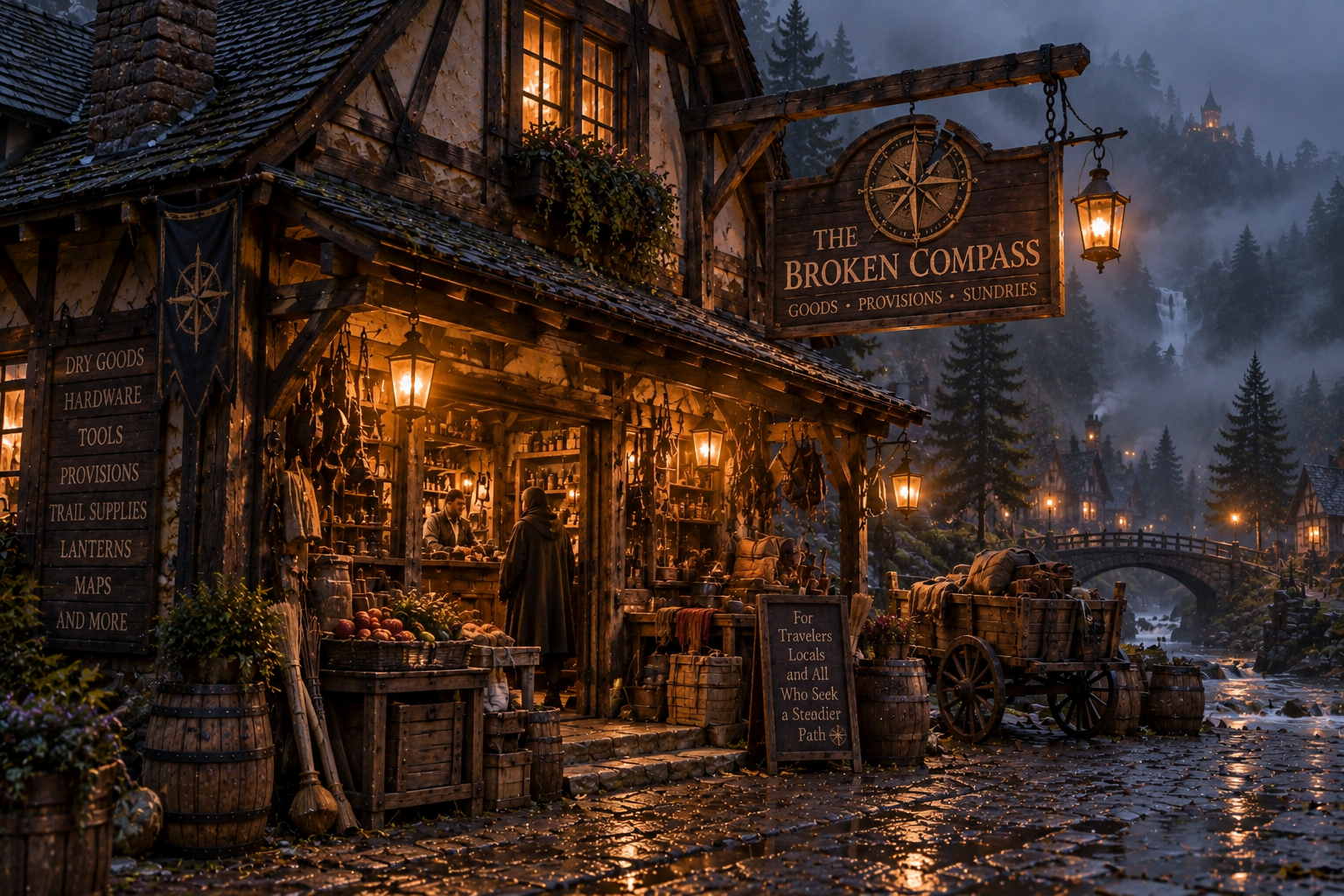
      THE BROKEN COMPASS - The Broken Compass is the closest thing the foggy village has to a proper general store. Sitting along one of the busier cobblestone streets, the old two-story timber-and-stone building is perpetually surrounded by barrels, crates, sacks, bundles of rope, firewood, and the occasional merchant's cart waiting to be unloaded. A weathered wooden sign hangs over the entrance bearing a compass rose with its needle snapped neatly in two.

The name is an old village joke: once you've reached this place, a compass isn't going to help you much anyway.

Inside, the Broken Compass is wonderfully crowded. Shelves climb almost to the rafters, packed with everything from lantern oil and candles to blankets, cookware, nails, rope, fishing tackle, dried provisions, tools, inexpensive clothing, boots, parchment, ink, lamp glass, and whatever oddities have arrived with the latest merchant caravan. Narrow aisles wind between stacks of crates, and customers occasionally have to turn sideways to pass one another.

For adventurers, there's an especially interesting section near the back. Packs, bedrolls, climbing gear, torches, maps, ammunition, basic weapons, and other traveling equipment can usually be found there. Nothing particularly exotic—but almost everything practical.

The store also has a reputation for acquiring unusual things.

A box arriving from outside the valley might contain imported wine one week, strange Feywild mushrooms the next, and six pairs of military boots nobody remembers ordering the week after that. The proprietor rarely seems surprised.
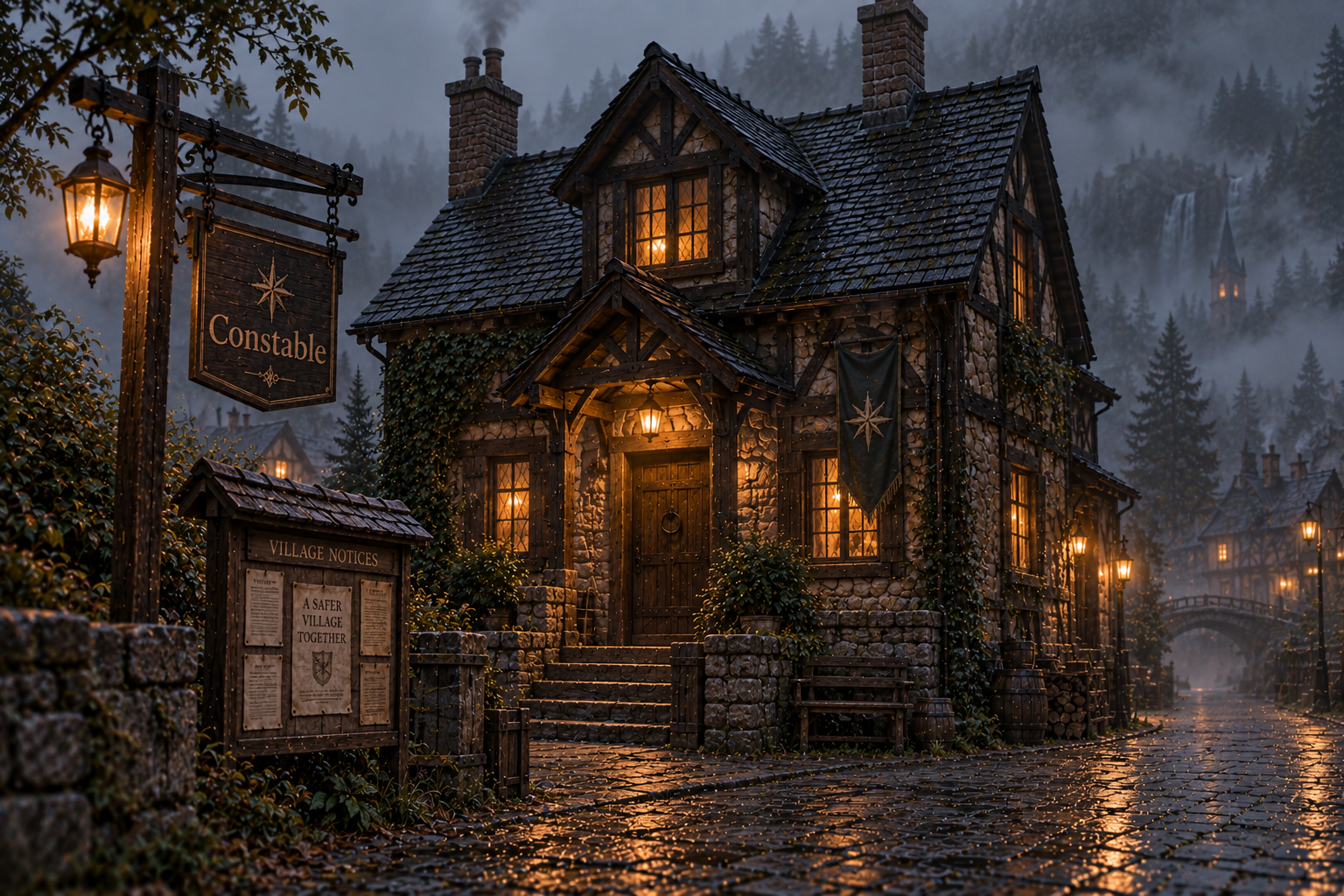
      THE CONSTABLE'S OFFICE - The Constable’s Office stands along one of the village’s main cobblestone streets, a sturdy two-story building of dark timber and rough mountain stone. It isn't a fortress or barracks. It looks more like an old, respectable village home that gradually accumulated the responsibilities of keeping order. A simple wooden sign outside reads CONSTABLE, illuminated by a lantern that burns through the fog each night.

Inside, the building is warm, practical, and slightly overcrowded. The front room serves as the public office and watch room, with Rennin’s heavy wooden desk occupying one side and a long table for his deputies on the other. Maps of the village and surrounding valley cover the walls alongside patrol schedules, missing-person notices, warrants, and handwritten reports. A large notice board near the entrance is crowded with announcements and wanted posters.

Rennin's desk is organized in a way that only Rennin understands. There are neatly stacked official reports beside half-finished correspondence, maps covered with annotations, evidence bags, sealing wax, and a perpetually cooling mug of something he forgot he was drinking. His green cloak usually hangs from a peg behind the desk when he's inside.

A small armory occupies a locked room toward the rear, containing shields, crossbows, spears, manacles, lanterns, and equipment for the deputies. Beside it are two modest holding cells—stone-walled, iron-barred, and deliberately uncomfortable without being cruel. Most occupants are drunks waiting to sober up, petty thieves, or villagers who made exceptionally poor decisions at the Wrong Turn Tavern.

Upstairs are Rennin's private office, records storage, and a small room where an exhausted deputy can sleep between shifts. Rennin keeps older case files here, including several locked cabinets containing investigations that were never satisfactorily resolved.

The building has a back entrance opening onto a small enclosed yard, where the deputies practice, store equipment, and occasionally bring prisoners inside without marching them through the front office.

Despite being the center of village law, the place doesn't feel oppressive. Villagers wander in to report missing livestock, settle arguments, complain about noise, ask for help, or simply tell Rennin something they think he ought to know. Children occasionally appear with reports of suspicious strangers that turn out to be unusually shaped tree stumps.

Rennin takes all of them seriously.

What gives the office its character is Rennin himself. For all the authority represented by the weapons, cells, and official notices, he doesn't rule the village from behind his desk. He spends much of his time walking its streets, talking to people, and knowing his community personally.

There is, however, one feature of the office that visitors eventually notice.

Beside Rennin's desk hangs an enormous map of the village covered with colored pins, strings, dates, names, and tiny handwritten notes. Wererat activity, unexplained disappearances, strange deliveries, Fey incidents, suspicious newcomers, and dozens of seemingly unrelated occurrences have all found their way onto it.

Rennin calls it his "unfinished business."

Cornelia and Cornwalis call it "the board where Rennin keeps discovering things we already knew."
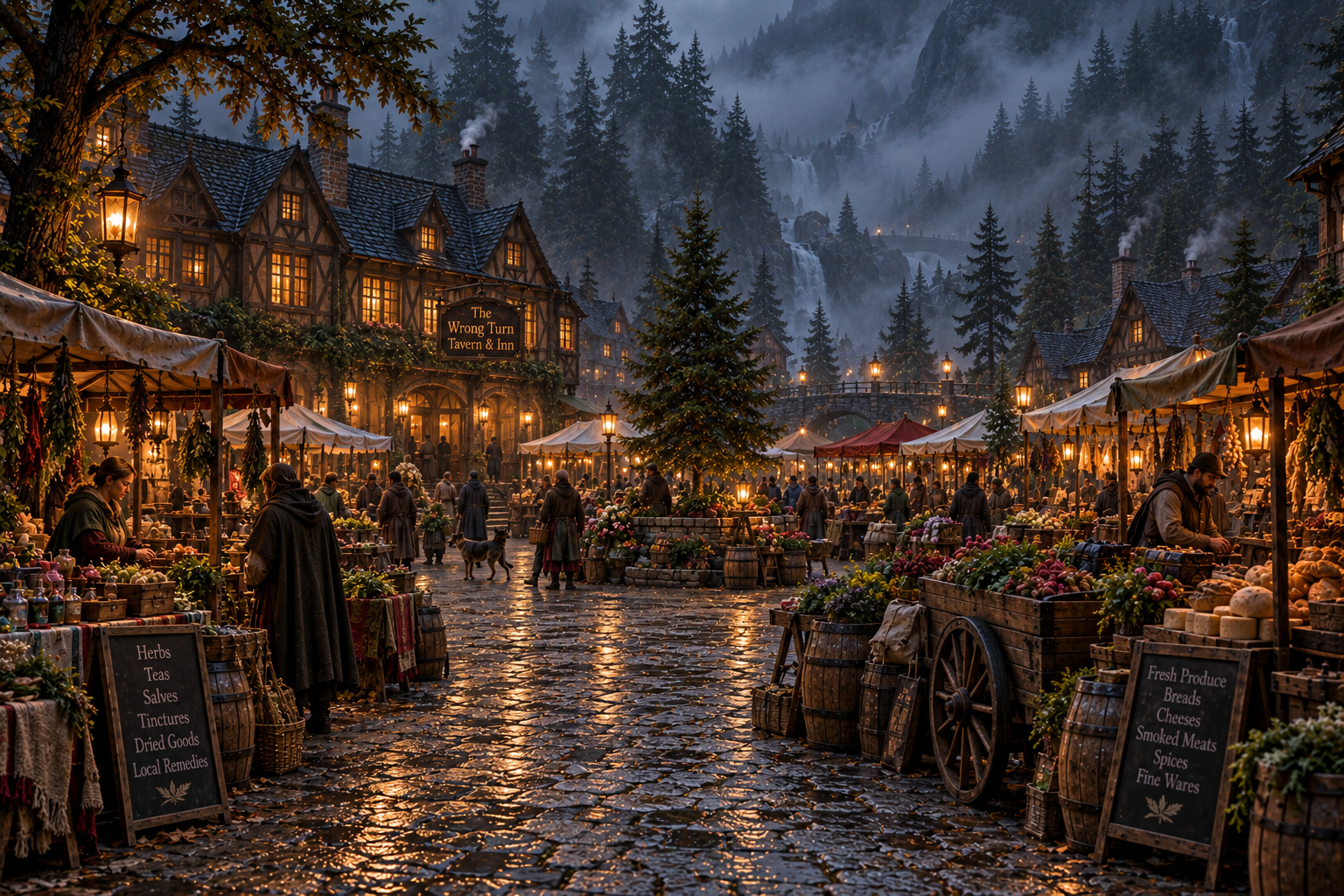
      THE CENTRAL PLAZA - The Central Plaza is the beating heart of the foggy village—a broad, irregular square of ancient cobblestone where nearly every road eventually seems to lead. Surrounded by timber-framed shops, homes, guildhouses, and taverns, it is rarely empty. Even beneath the perpetual gloom, the plaza feels alive.

Dozens of iron lanterns stand around its perimeter and hang from neighboring buildings, their warm amber glow reflecting from cobblestones perpetually darkened by mist. The Lamplighter Guild takes particular pride in the plaza; not a single lantern here is permitted to go dark. Cornelia and Cornwalis would probably consider such an occurrence a personal insult.

During the day, the plaza becomes the village's principal marketplace. Wooden carts and temporary stalls appear in seemingly random arrangements, selling vegetables, mountain herbs, bread, smoked meats, tools, pottery, cloth, firewood, and goods brought into the valley by traveling merchants. Farmers argue over prices, children weave between carts, dogs investigate unattended baskets, and merchants loudly insist that whatever they're selling is considerably rarer than it actually is.

At night, most of the carts disappear and the plaza changes character. The crowds thin, doors close, and fog begins creeping between the buildings. Lanterns become islands of amber light surrounded by gray. Footsteps echo strangely across the wet stones, and someone crossing the plaza can sometimes hear another person walking long before they emerge from the mist.

A massive old pine tree grows near one side of the square. Nobody remembers it being planted. A circular stone bench surrounds its trunk, making it a favorite meeting place for villagers. During festivals its branches are decorated with lanterns, ribbons, and small charms.

A public notice board stands near the main road, perpetually covered in proclamations, advertisements, missing-animal notices, job postings, handwritten complaints, and pieces of paper Rennin wishes people would stop putting there.

There is also a small raised stone platform along one edge of the plaza. Most days it serves as somewhere for merchants, musicians, and village criers to stand. On important occasions, the Burgomaster uses it to address the village. During the Lantern Festival it becomes a stage for performers, speeches, drinking contests, and whatever questionable entertainment Cornelia and Cornwalis have arranged that year.

The plaza is particularly spectacular during the Lantern Festival. Market stalls remain open late, musicians play in the streets, food and drink flow freely, and hundreds of lanterns illuminate the surrounding buildings. When the Astrolabe releases its yearly pulse and the fog briefly retreats, the entire village gathers here to look upward at a sky many of them rarely see.

More than anything, the Central Plaza is where village life becomes public.

News is announced here.

Arguments happen here.

Adventurers are noticed here.

Strangers are remembered here.

And if something extraordinary happens anywhere in the village, it usually isn't long before someone runs into the plaza shouting about it.

Which means Cornelia and Cornwalis generally knew about it five minutes earlier.
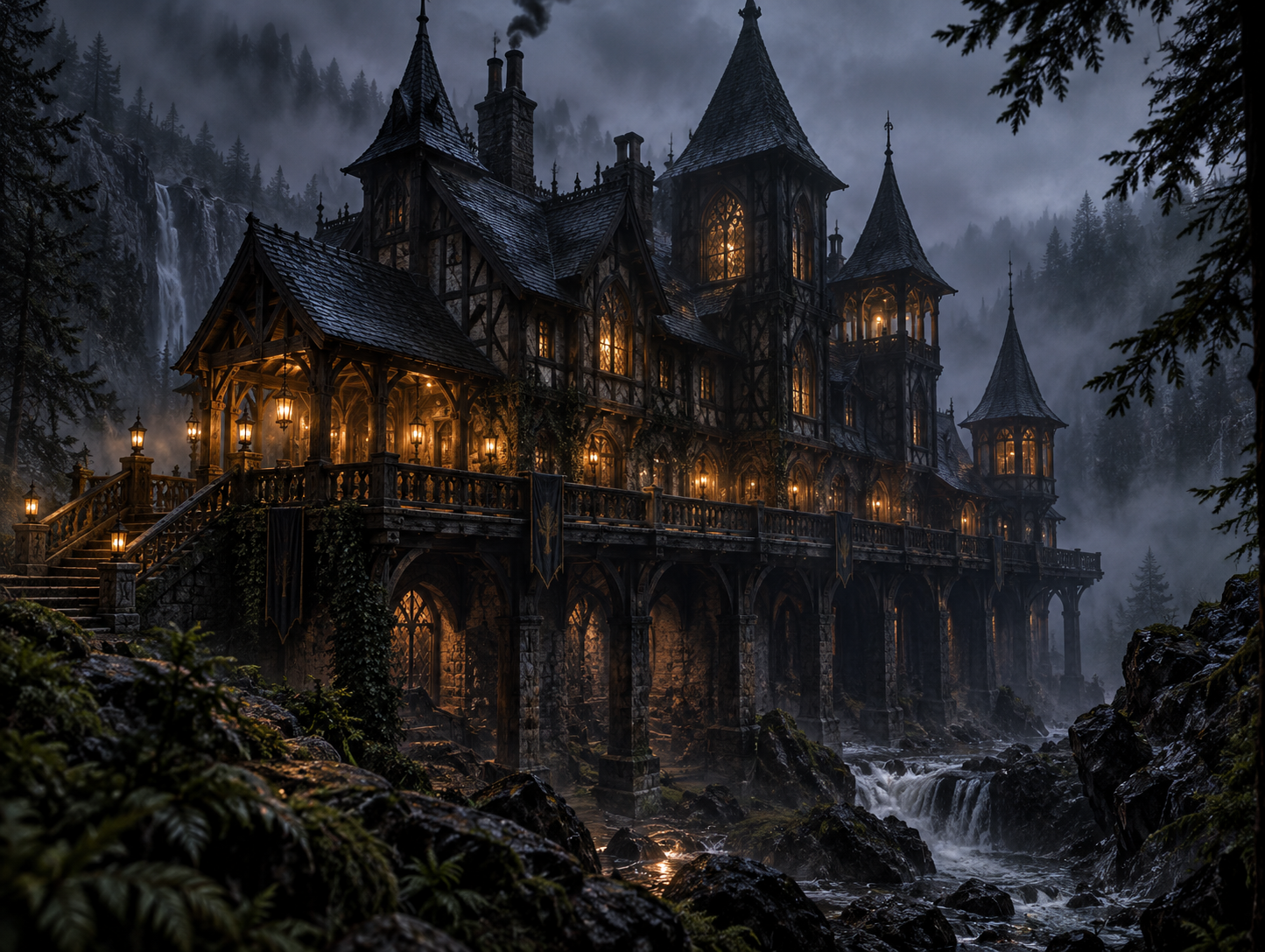
      VAILMERE MANNOR, BURGOMASTER RESIDENCE - The home of the Burgomaster and his reclusive elven wife stands in one of the village’s wealthier quarters, removed from the crowded shops and workshops of the central streets. It is an impressive three-story manor of pale stone, dark timber, and steep slate roofs.  Even beneath the village’s perpetual fog, the house manages to look dignified—and perhaps a little too pleased with itself.

The Burgomaster would call it modest.

Nobody else does.

Unlike many village homes that seem to have grown organically over generations, the residence is intentional in its imposing nature, orderly, and meticulously maintained. Ivy is permitted to grow on the walls, but only where it looks attractive. Hedges are trimmed. Brass fittings are polished. Lanterns flank the front entrance, and the cobblestone path is kept suspiciously free of mud, weeds, and moss.

Inside, the house reflects the personalities of its owners.

The Burgomaster favors heavy furniture, impressive portraits, trophies, maps, expensive rugs, and objects intended to remind visitors that they are speaking with an important man. His study contains an enormous desk positioned so guests must approach it, shelves filled with official records, bottles of excellent brandy, and a large portrait of himself that is considerably more heroic than anyone remembers him looking.

His wife has brought an entirely different refinement to the house. Her rooms possess the unmistakable elegance of old elven nobility—delicate furniture, silverwork, ancient books, fine porcelain, pale fabrics, carefully cultivated flowers, and pieces of elven artwork that are probably worth more than several neighboring houses combined.

The result is an odd but beautiful marriage of blustering human wealth and restrained elven aristocracy.

The main floor contains a formal receiving room, dining hall, library, kitchen, and the Burgomaster’s office. A large hearth keeps the central sitting room warm, although guests quickly discover that there is a considerable difference between being received here and being welcomed.

Upstairs are the couple's private chambers and several immaculate guest rooms. His wife's chambers overlook the gardens and contain a small private sitting room where she receives few people.

Behind the residence is a walled garden, unusually lush despite the village's limited sunlight. Lanterns hang from small iron posts along its paths, illuminating sculpted shrubs, mountain flowers, benches, and a small stone fountain. His wife takes considerably more interest in the garden than her husband does.

The residence is also a place where much of the village's unofficial politics happens. Wealthy merchants come for dinner. Guild leaders arrive through the front door. Petitioners wait nervously in the receiving room. Rennin occasionally appears carrying some unpleasant problem the Burgomaster would rather not hear about.

And Cornelia and Cornwalis somehow know what was discussed before breakfast the following morning.

The Burgomaster is convinced someone on his household staff is informing them.

His wife suspects otherwise.

She once noticed a Lamplighter repairing the lantern outside her bedroom window at eleven o'clock at night.

It didn't require repairing.
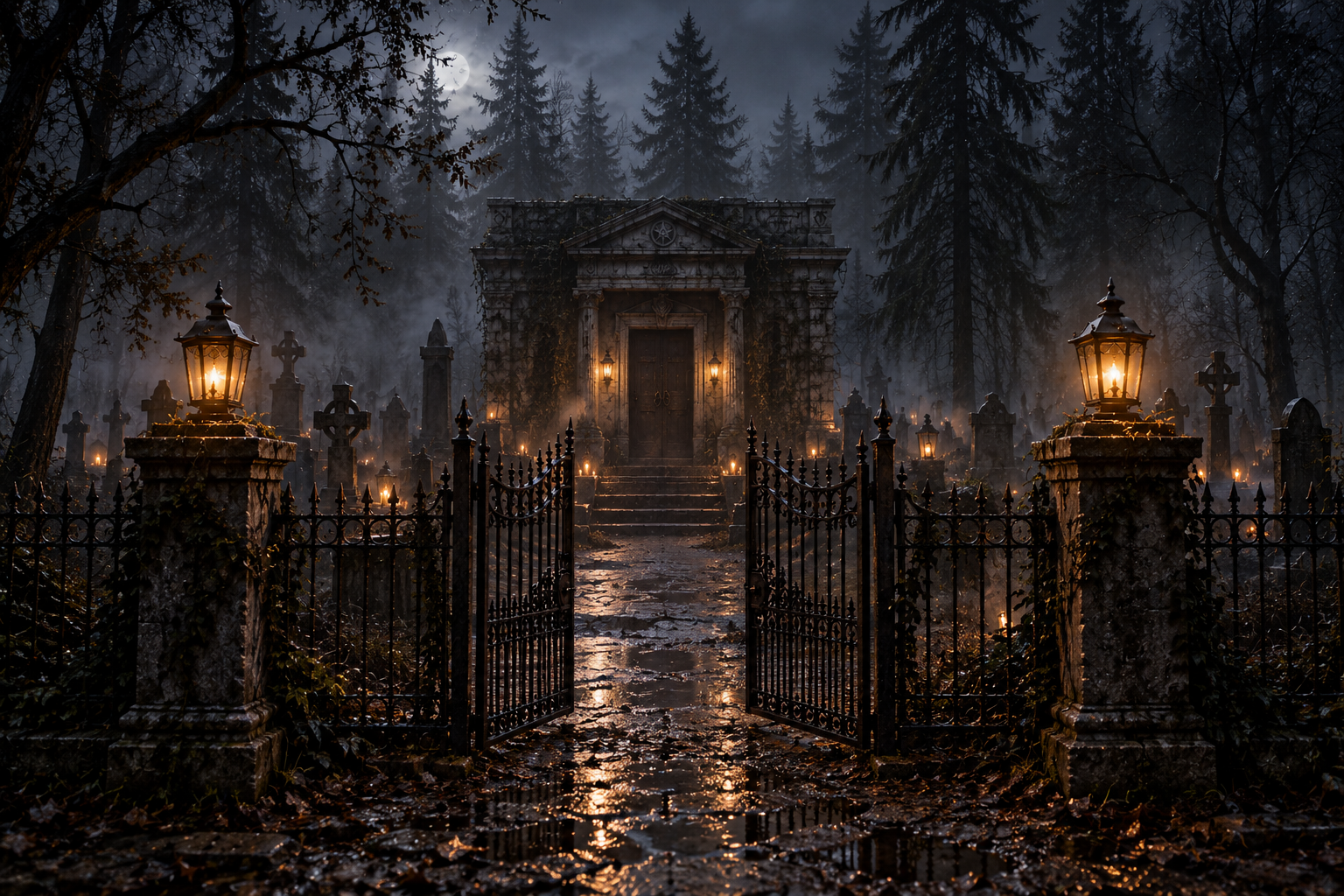
      STILLGARDEN CEMETERY - The village graveyard lies near the outer edge of town where the cobblestones give way to dark pines, moss-covered boulders, and rising mountain slopes. An old wrought-iron gate marks the entrance, flanked by two stone pillars upon which lanterns burn every night. Beyond them, a narrow path winds through weathered headstones before ending at the old stone mausoleum.

The graveyard is ancient—far older than much of the village surrounding it.

Generations of villagers rest here. Some graves are marked by elaborate carved stones, others by little more than worn slabs whose names have disappeared beneath centuries of rain and moss. Families traditionally leave small lanterns beside the graves of loved ones, so on certain nights dozens of tiny flames flicker throughout the cemetery, appearing and disappearing as the fog moves between them.

It is a beautiful place during the day.

At night, considerably less so.

The fog seems particularly reluctant to leave the graveyard. It pools between the stones and curls around ankles as visitors walk the paths. Sound behaves strangely here as well. The village might only be a short walk away, yet beyond the iron gates its taverns, mills, and streets seem impossibly distant.

At the far end stands the mausoleum.

Built from enormous blocks of dark gray stone, the structure is partially covered in ivy and mountain moss. Broad steps lead between weathered columns to a pair of heavy doors. The carvings above them have been worn nearly smooth, though careful examination reveals symbols that don't correspond to any family currently living in the village.

Nobody seems entirely certain whose mausoleum it originally was.

Inside, the air is cold and smells of stone, dust, old incense, and damp earth. Stone alcoves line the walls, containing the remains of several prominent villagers from generations past. Candle niches have been carved into the walls, and villagers still occasionally leave flowers, coins, or small personal objects upon the tombs.

But the mausoleum has another purpose.

A concealed stairway descends beneath it into the older crypts below the graveyard. These chambers predate the mausoleum itself. Rough stone corridors lead through burial chambers, collapsed passages, and forgotten tombs before eventually reaching the natural caverns beneath the village—the same strange underground world of subterranean water, phosphorescent moss, and glowing mushrooms that the party has already encountered.

Most villagers know there are crypts beneath the mausoleum.

Very few understand how far down they actually go.

Rennin keeps the cemetery gate watched whenever anything unusual happens in the village, and even the Lamplighters make certain the lanterns along its perimeter remain especially well maintained.

Cornelia and Cornwalis have only one piece of advice concerning the graveyard:

If you see a lantern moving among the graves after midnight, make sure someone is carrying it.
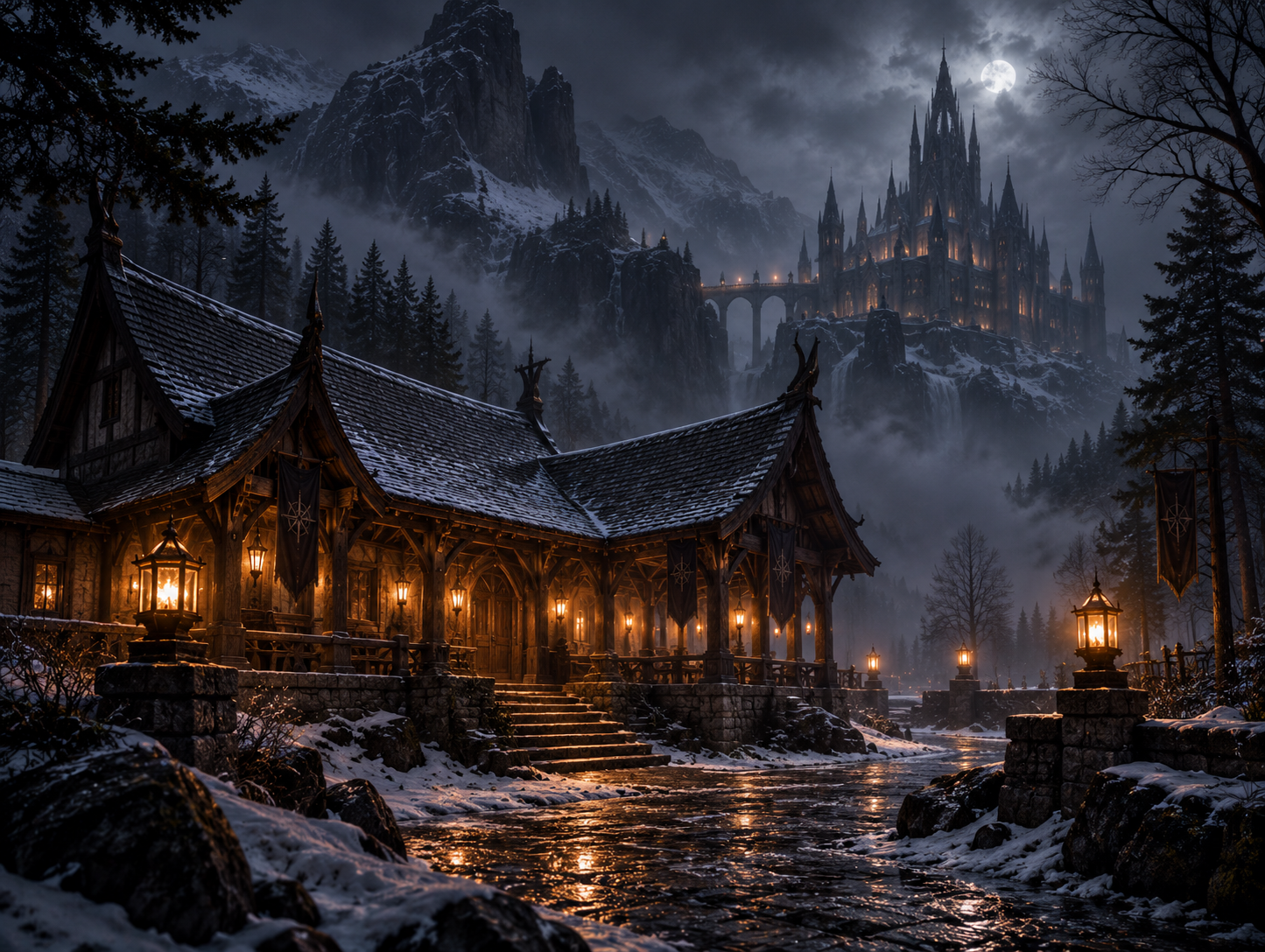
      ERYNDRAEL MONASTERY AND THE MEETING HOUSE - High above the village, where the last cobblestone paths disappear beneath pine needles and the mountain becomes steep and unforgiving, stands the Eryndrael Monastery—an ancient sanctuary inhabited by an isolated order of elven warrior-monks.

From the village below, very little of the monastery can actually be seen. Occasionally the fog parts enough to reveal dark roofs, narrow towers, or the faint glow of lanterns impossibly high among the cliffs. A winding stone stairway climbs toward it through enormous pines and moss-covered boulders before disappearing completely into the mist.

The monks have lived upon the mountain for longer than anyone in the village can reliably remember. They rarely come down except for supplies, important ceremonies, or matters they consider threatening to the valley. They are courteous when encountered, but distant and intensely private.

There is one rule every villager knows:

You may climb as far as the Meeting House. No farther.

The Meeting House

About halfway up the mountain stands a timber-and-stone building known simply as the Meeting House.

It marks the boundary between the village and the monks.

The building is deliberately welcoming: a broad hearth, simple wooden tables, benches, a kettle perpetually kept warm, and several lanterns glowing beneath its covered porch. Villagers seeking the monks come here and ring a large bronze bell suspended beside the entrance.

Then they wait.

Eventually, one or more monks descend from the fog.

Trade takes place here. Disputes are discussed here. Rennin occasionally meets representatives of the order here. The sick may be brought here when someone believes the monks possess knowledge that Stone and Root cannot provide.

But the monks never invite villagers beyond it.

Behind the Meeting House stands a stone gateway without a gate. Beyond it, the path continues upward through the forest.

A simple inscription has been carved into the stone:

BEYOND THIS STONE, YOU WALK UNINVITED.

There are no guards.

There don't need to be.

Beyond the Boundary

The path above the Meeting House becomes increasingly ancient. Cobblestones give way to enormous weathered steps cut directly into the mountain. Small stone lanterns appear along the trail, burning with a faint blue-white flame that never seems affected by wind or rain.

Eventually the forest opens onto the monastery itself.

The Veiled Summit is not luxurious. It is a sprawling collection of ancient stone halls, wooden galleries, meditation chambers, courtyards, training grounds, shrines, and covered walkways constructed against the mountainside. Some buildings are partially carved directly into the rock.

There are no defensive walls.

That fact becomes considerably more intimidating once someone understands who lives there.

The elves train constantly.

At dawn they meditate.

Afterward comes weapons practice—quarterstaffs, spears, swords, bows, and unarmed combat. Their movements are extraordinarily disciplined and almost unnaturally synchronized. Some of the eldest monks have trained here for centuries.

Villagers occasionally hear distant bells or the rhythmic crack of wooden training weapons echoing down the mountain.

And Cornelia and Cornwalis—who normally have an irritating amount of information about everything—become unusually evasive whenever anyone asks what lies beyond the Meeting House.

Cornelia once offered only:

“Some doors are locked because somebody wants to keep you out.”

Cornwalis quietly added:

“And some are locked because somebody wants to keep something else in.”
      THE RIVERWATCH - Perched on a natural rise above the main branch of the river, the Riverwatch is one of the finest—and most secluded—places from which to look across the heart of the village. It isn't really a building at all, but an old stone overlook and gathering place, reached by a narrow cobblestone path climbing between pines and moss-covered boulders.

A broad semicircular terrace of weathered stone extends toward the edge of the hillside. A waist-high stone wall follows its perimeter, worn smooth in places by generations of villagers leaning against it. Several heavy wooden benches sit beneath the pines, and a small covered shelter provides protection from the seemingly endless drizzle.

From here, the village spreads out below.

The main river dominates the view, winding between buildings and disappearing beneath old stone bridges. On cold evenings, pale mist rises from its warmer waters and mingles with the fog drifting through the streets.

Directly across the river lies the center of the village. Through breaks in the mist, the strange silhouette of the Astrolabe can be seen rising above its plaza, its metal rings occasionally catching lantern light as they slowly turn.

Nearby stands the welcoming bulk of the Wrong Turn Tavern, its glowing windows among the brightest things visible from the overlook. On particularly foggy nights, the village itself can almost disappear, leaving only those windows and scattered street lanterns suspended like distant stars in the gray.

A handful of iron lanterns line the Riverwatch's stone wall. The Lamplighters maintain them obsessively, giving the terrace a warm amber glow without spoiling the view.

The Riverwatch has become an unofficial meeting place for people who want to talk away from the ears of the Central Plaza. Friends gather here with bottles from the tavern. Lovers meet beneath the pines. Rennin occasionally conducts conversations here when he doesn't want them taking place in his office. Travelers come simply to sit and watch the river.

There is even an old stone table near the center of the terrace, making the place useful for spreading out maps, sharing food, or holding a quiet meeting.

At night, when the fog is thickest, the Riverwatch becomes extraordinarily peaceful. The rush of the river rises from below, lanterns shimmer through the mist, and somewhere in the distance comes the muffled noise of the Wrong Turn Tavern.

And above it all, whenever the fog shifts just enough, the Astrolabe can be seen slowly turning.


The irony, of course, is that villagers consider the Riverwatch an excellent place for private conversations.

Cornelia and Cornwalis have never corrected them.
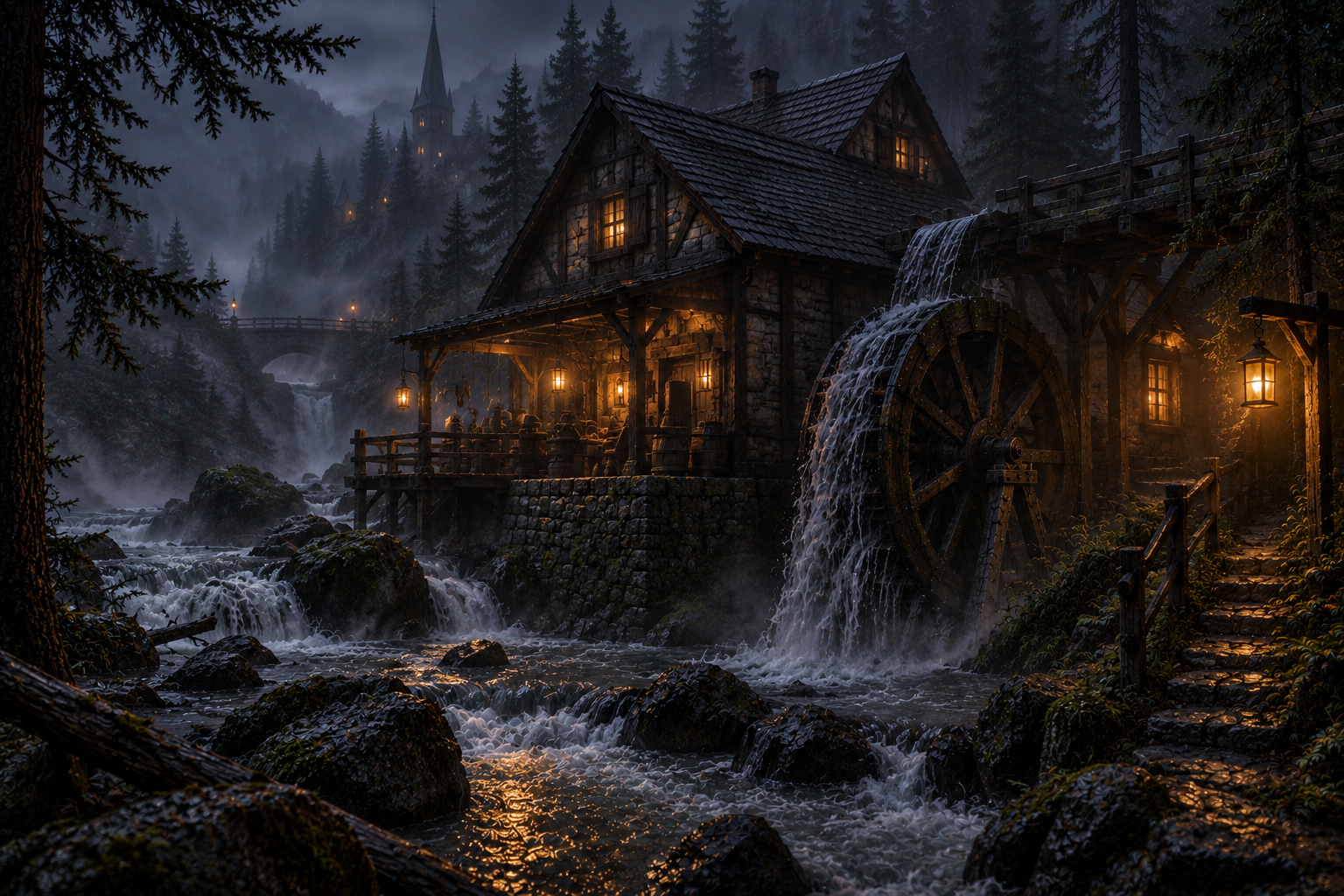
      MILLER'S FOLLY - Miller’s Folly is an old water-powered grain mill standing near the edge of the village where one of the mountain rivers narrows between great moss-covered boulders. Built from heavy gray stone and dark, weathered timber, the mill looks as though it has been clinging stubbornly to the riverbank for centuries. Pines crowd close around it, and on most mornings the building is half-hidden behind river mist and the village’s ever-present fog.

The mill takes its name from Edmund Miller, the stubborn craftsman who built it generations ago.

Everyone warned Miller that the river was too unpredictable. Spring runoff would destroy it. Winter ice would tear away the wheel. The foundation would sink. The river would change course.

Miller built it anyway.

When the mill survived its first winter, villagers started calling it “Miller’s Folly” as a joke.

When it survived the next hundred winters, the name became one of reluctant admiration.

The great wooden waterwheel still turns, slowly and relentlessly, groaning beneath the force of the dark mountain water. Inside, enormous wooden gears rotate overhead while belts, shafts, and millstones fill the building with a constant rhythmic clack... groan... thump... clack. Flour dust hangs in the air, covering beams, barrels, sacks, and occasionally the miller himself in a thin coating of white.

The ground floor is a working maze of grain sacks, scales, barrels, wooden chutes, tools, and enormous millstones. A narrow staircase leads to the upper floor where grain is stored before being fed into the machinery. Beneath the mill is an older stone foundation containing maintenance passages that allow access to the wheelworks and the river channel.

Few villagers enjoy going down there.

The sound of the river becomes deafening beneath the building, lantern flames behave strangely in the damp air, and there are sections of the foundation that clearly predate Edmund Miller’s mill.

Outside, a narrow stone bridge crosses the river nearby. A muddy loading yard provides room for wagons bringing grain from farms outside the village, while a small covered platform allows sacks of flour to be loaded without being soaked by the seemingly perpetual drizzle.

Despite its lonely appearance, Miller’s Folly is enormously important. Much of the village's grain passes through its doors. Bakers depend upon it, farmers gather there to trade news, and carts regularly travel between the mill and the Central Plaza.

The Lamplighters maintain three lanterns along the road and another beside the mill door. All four are kept burning throughout the night.

There used to be five.

The fifth stood beside the river below the waterwheel.

Every time the Lamplighters replaced it, something extinguished it before morning.

Eventually Cornelia and Cornwalis stopped replacing it.

When asked why, Cornwalis simply says:

“There's fighting the gloom, and then there's irritating it.”
      THE EMBERWAY - The Emberway is the main route leading away from the village and into the dense evergreen forest surrounding the valley. It begins as a proper cobblestone lane near the outer homes, but within a few hundred yards the stones become uneven and moss-covered, eventually narrowing into a winding forest path beneath towering pines and firs.

The road takes its name from the lanterns that mark its course.

Simple iron lanterns hang from weathered wooden posts at regular intervals. Their warm amber flames resemble tiny embers floating in the darkness, each positioned so that a traveler standing beneath one can usually make out the faint glow of the next through the fog.

The Lamplighter Guild maintains every one of them.

The forest surrounding the Emberway is remarkably beautiful. Ancient trees rise into a canopy almost completely lost in mist. Ferns, mushrooms, moss-covered boulders, fallen logs, and mountain flowers crowd the forest floor. Small streams occasionally cross beneath old stone culverts or simple wooden footbridges.

But the farther one travels from the village, the quieter the forest becomes.

The sounds of taverns, mills, flowing rivers, and village life slowly disappear. Soon there is only the crunch of boots against the path, the whisper of wind through pine needles, and the occasional groaning of enormous trees somewhere beyond the lantern light.

Fog gathers heavily between the trunks.

Sometimes it becomes so thick that the forest beyond the path simply seems to cease to exist.

That is why the lanterns are more than conveniences.

Each little flame represents a boundary between the familiar and the unknown—a reminder that the village still reaches this far.

Travelers have an old custom when walking the Emberway after dark. Upon reaching each lantern, they briefly place a hand against its wooden post before continuing onward.

Nobody remembers exactly why.

Most villagers do it anyway.

There are stories, of course.

Travelers occasionally claim to have seen another lantern moving through the forest, traveling parallel to the Emberway where no trail exists. Others speak of hearing footsteps among the trees, following them from one pool of light to the next and stopping whenever they stop.

Cornelia and Cornwalis dismiss most of these stories with their usual smiles.

What they don't dismiss is an extinguished lantern.

If a single lantern along the Emberway goes dark, the Lamplighters replace it before the following night.

If two consecutive lanterns are found extinguished, Rennin is informed.

And if three lanterns go dark at once, the Emberway is closed.

No argument.

No exceptions.

Nobody in the village seems particularly eager to explain why.

So anyone traveling the Emberway after sunset learns the same piece of advice:

Stay on the Emberway. Keep the next lantern in sight.

And if you see a light moving among the trees, don't follow it.
      THE COLD FORGE - Near the older edge of the village stands a shuttered weaponsmith and armory known simply as The Cold Forge. Once one of the busiest workshops in the valley, it has been abandoned for years.

The building is a broad, two-story structure of heavy stone and blackened timber, built to withstand the heat and sparks of a working forge. A squat stone chimney rises from its moss-covered roof, but no smoke has emerged from it in a very long time. Ivy has climbed across much of the masonry, ferns grow between the cobblestones, and weeds have overtaken what was once the loading yard.

Unlike a ruin, however, The Cold Forge is remarkably intact.

Its windows aren't broken. Its roof hasn't collapsed. The enormous iron-bound front doors remain securely closed. Through the dusty glass, one can still make out weapon racks, armor stands, workbenches, and tools hanging exactly where their owner left them.

That's what makes the place unsettling.

It doesn't look destroyed.

It looks abandoned in the middle of a working day.

Its last master was Haldric Voss, one of the finest weaponsmiths the village had ever known. Haldric wasn't a wizard, but he possessed an uncanny talent for metalwork. A blade leaving his forge held an edge for years, and armor bearing his maker's mark was sought after throughout the valley.

Then Haldric received an unusual commission.

A traveler brought him several ingots of strange black metal recovered somewhere beneath the mountains. The stranger wanted the metal forged into a sword and offered enough gold that Haldric couldn't refuse.

The metal behaved unlike anything he'd worked before.

It required tremendous heat but never seemed to glow properly. Sparks from it burned a strange pale color. Haldric began working at night, becoming increasingly obsessed with finishing the weapon. Neighbors remembered hearing his hammer long after midnight.

Clang.

Clang.

Clang.

Night after night.

Then, one morning, it stopped.

When Haldric failed to open the shop, Rennin's predecessor eventually entered.

The forge was cold.

Haldric was gone.

There was no blood. No sign of violence. No forced entry. His coat still hung beside the door. His breakfast remained on the table upstairs.

And sitting upon the anvil was the unfinished black blade.

Nobody ever found Haldric Voss.

The Burgomaster ordered the forge closed. The strange weapon was supposedly removed and locked away, and eventually the building passed into village ownership. Several attempts have been made to sell it, but every prospective buyer has changed their mind.

Because sooner or later, anyone spending enough time near the building notices the same thing.

On particularly foggy nights, sometime after midnight, the forge begins working again.

There is no fire in the chimney.

There is no light behind the windows.

But from inside comes the unmistakable sound of a smith's hammer striking an anvil.

Clang.

A long silence.

Clang.

Another silence.

Clang.

The Lamplighter Guild still maintains the lantern outside The Cold Forge.

Cornelia and Cornwalis have given their people very specific instructions:

Light the lantern. Don't look through the windows. And if you hear hammering, don't knock.
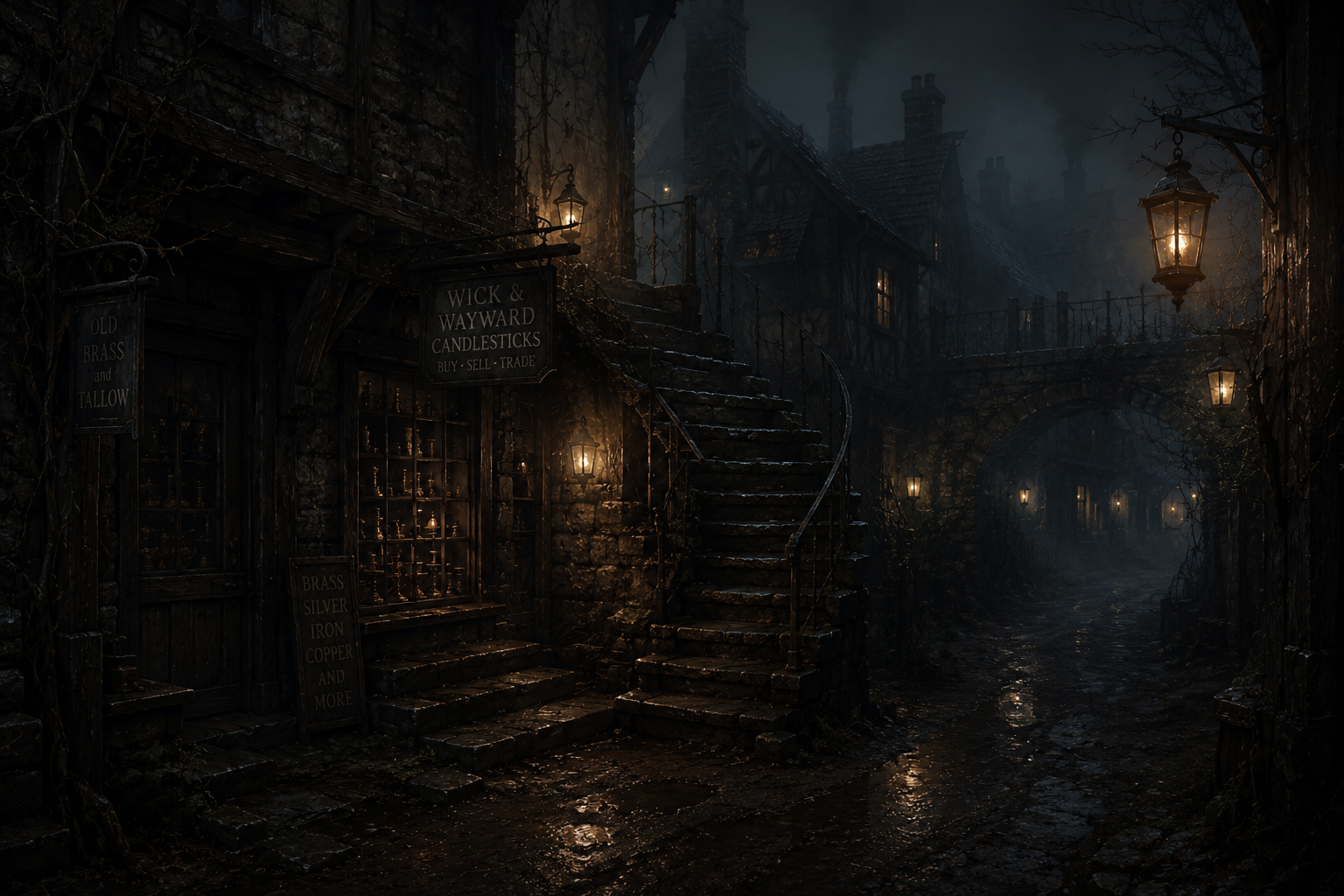
      WICK & WAYWARD - Wick & Wayward sits in one of the older, less respectable corners of the village, down a narrow cobblestone lane where the buildings crowd closer together and the lanterns never seem quite as bright.

From the street, it appears to be an eccentric little shop specializing in candles, candlesticks, lanterns, lamp oil, incense, and odd pieces of household metalwork. Its windows are crowded with brass candleholders, iron lanterns, bundles of colored candles, little oil lamps, and tarnished silver pieces whose origins are sometimes difficult to explain.

The name is painted discreetly above the entrance:

WICK & WAYWARD

Inside, the shop is warm, cramped, and pleasantly chaotic. Hundreds of candles illuminate shelves overflowing with merchandise. Wax has accumulated in colorful layers upon old tables and counters. Bundles of herbs and incense hang from the rafters, filling the air with scents of beeswax, cedar, cinnamon, smoke, and something faintly exotic.

The proprietor will happily sell you a candle.

They'll also buy things.

No questions asked.

A silver goblet you inherited from your grandmother? Certainly.

An expensive necklace you inexplicably found in an alley?

Also certainly.

A jeweled dagger bearing the crest of a noble family that reported a remarkably similar dagger stolen three days earlier?

The proprietor might pause.

Then reach beneath the counter for the better scales.

Everyone knows Wick & Wayward deals in secondhand goods.

Most villagers simply choose not to ask how secondhand.

Rennin has searched the place more than once.

He's never found anything.

The Guild Beneath the Wick

What almost nobody knows is that Wick & Wayward is merely the front door to something considerably larger.

Not literally, of course.

That would be far too obvious.

The entrance to the village's Thieves Guild isn't actually inside the shop. Instead, Wick & Wayward serves as a marker and screening point. Someone who knows the proper phrases can leave a message, arrange a meeting, fence stolen property, or request the services of someone who specializes in problems respectable businesses don't handle.

The actual guildhall lies nearby beneath the oldest section of the neighborhood.

A twisting network of forgotten cellars, storage tunnels, old drainage passages, and chambers carved into the stone beneath the streets has been quietly connected over generations. Somewhere within that maze is a concealed entrance leading into what guild members simply call: The Underwick.

The contrast with Wick & Wayward is immediate.

The Underwick is surprisingly comfortable and lavish.

Thick rugs cover old stone floors. Lanterns hang from timber beams. Maps cover the walls. There are couches, gambling tables, a small bar, private booths, training rooms, storerooms, and numerous little alcoves where conversations can occur without attracting attention.

And everywhere there are doors.

Some lead somewhere.

Some don't.

A few appear to lead somewhere but really don't.

And at least one doesn't appear to be a door at all.

The guild deliberately cultivates this confusion.

Members know the routes.

Visitors don't.

At the center of it all is Lady Tenebrae.

The middle-aged tiefling rogue rarely conducts business from behind a desk. She prefers an elegant chair near the hearth, a glass of wine within reach, surrounded by people who appear to be relaxing while quietly listening to everything happening around them.

Tenebrae doesn't behave like a criminal hiding beneath the village.

She behaves like a noblewoman receiving guests.

Because, in her mind, that's exactly what she is.

The Thieves Guild under Tenebrae isn't simply a collection of burglars. It is a network of thieves, smugglers, fences, informants, spies, counterfeiters, lockbreakers, gamblers, and people who specialize in obtaining things other people would prefer remain unobtainable.

Violence happens.

But Tenebrae considers unnecessary violence terribly unprofessional.

Stealing a nobleman's jewels without waking him demonstrates skill.

Stealing his jewels and murdering him demonstrates that you lack imagination.

The guild has an unusual relationship with the village.

Tenebrae permits theft.

She permits smuggling.

She permits blackmail under circumstances she finds sufficiently entertaining.

But certain activities are forbidden.

No trafficking. No harming children. No robbing Stone and Root. And nothing that deliberately threatens the survival of the village.

Breaking those rules doesn't bring Rennin.

It brings Tenebrae.

Most offenders would prefer Rennin.

There is even an unspoken understanding between the guild and the Constable's Office. Rennin knows organized crime exists within his village. Tenebrae knows Rennin knows.

Occasionally criminals disappear before Rennin can arrest them.

Occasionally information mysteriously appears on Rennin's desk.

Neither side acknowledges the arrangement.

Someone wishing to contact the Thieves Guild enters Wick & Wayward and asks:

“Do you have anything that burns without giving light?”

The shopkeeper responds:

“Only for those comfortable walking in the dark.”

If the visitor knows the proper response, arrangements are made.

They aren't immediately taken to the guildhall.

Instead, sometime later, they receive a black candle tied with a dark purple thread.

On the bottom is scratched a location and a time.

Go there alone.

Bring the candle.

Wait.

Someone will find you.

And that's the real secret of Wick & Wayward.

Everyone assumes the Thieves Guild is hidden somewhere beneath the shop.

It isn't.

Tenebrae encourages that rumor because it means anyone trying to find her spends their time watching the wrong building.

Cornelia and Cornwalis, naturally, know exactly where the real entrance is.

They've never told Rennin.

When he once asked Cornwalis directly, the halfling looked genuinely offended.

“Constable, we're Lamplighters. We don't go sneaking around dark tunnels.”

Cornelia waited until Rennin walked away.

Then added:

“That's why we bring lanterns.”
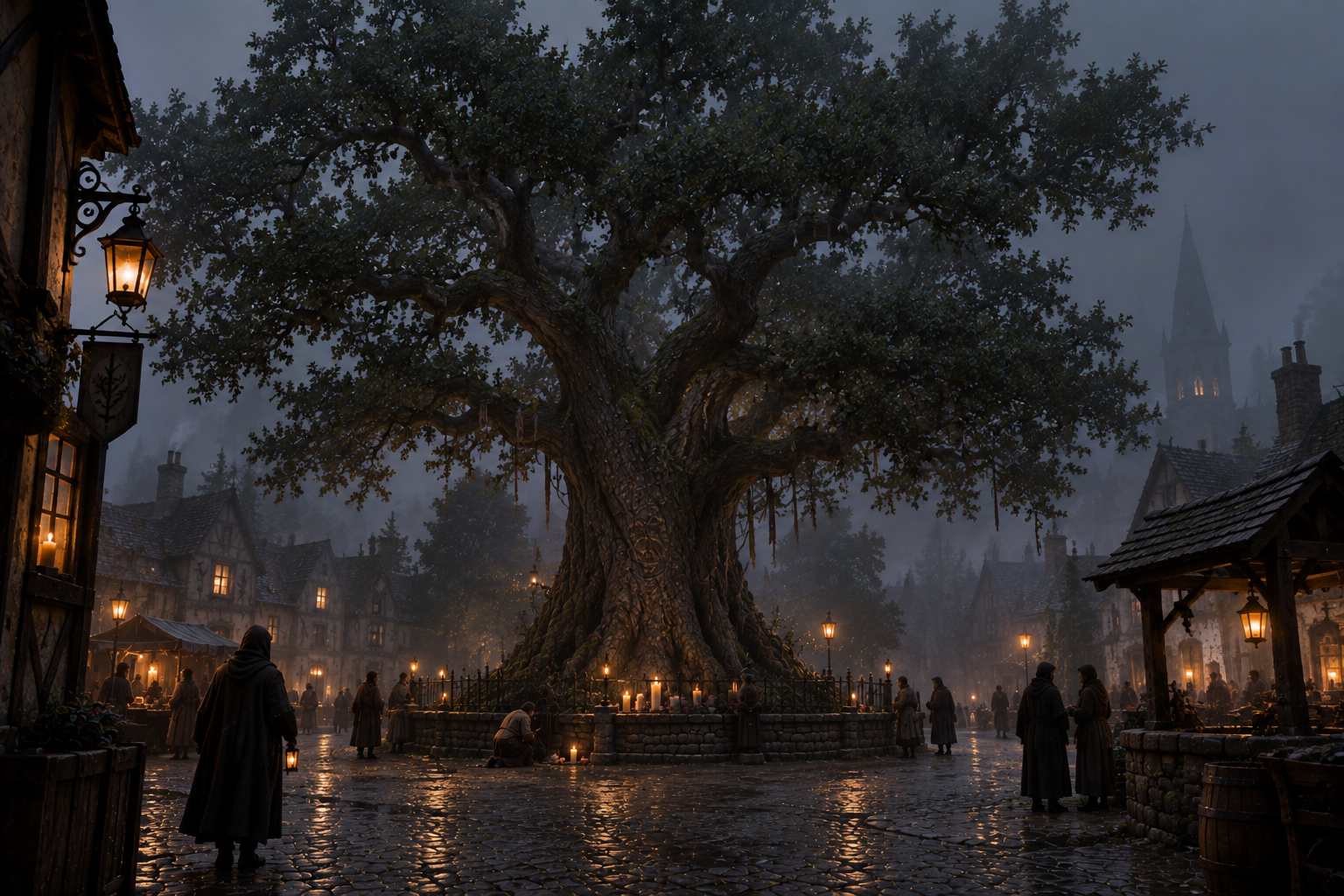
      THE ELSEWHERE OAK - No one remembers planting the Elsewhere Oak.

It stands alone in a small cobblestone square near the heart of the village—an enormous, ancient oak surrounded by mountain pines that should have choked it out centuries ago. Oaks do not grow naturally this high in the valley, yet the tree is larger and seemingly older than anything in the surrounding forest.

The oldest village records already mention it simply as “the old tree.” Even then, the writers spoke of it as something ancient.

The tree never seems affected by the valley’s strange climate. Frost does not kill its leaves. Heavy snow rarely settles on its branches. Its roots have lifted stones and cracked foundations nearby, yet no one has ever seen a root exposed beneath the tree itself.

There are other peculiarities.

Birds will perch in its branches, but never build nests there. Dogs sometimes stop at the edge of the square and refuse to approach. During heavy fog, villagers occasionally swear they can see shapes standing beneath the tree—only to find the square empty when they draw closer.

Carving into the bark is considered extraordinarily bad luck. Not because of any law or religious belief.

People simply don't do it.

Once, many years ago, the village council ordered one of its great limbs removed after it threatened the roof of a nearby home. Three woodsmen arrived that morning.

By sunset, the limb remained.

None of the three would ever explain what happened.

Perhaps strangest of all is an old village custom. When someone leaves the valley on a long journey, they touch the trunk of the Elsewhere Oak before departing.

When they return, they touch it again.

No one remembers how the tradition began.

And occasionally, after a violent storm or an especially heavy night of fog, something can be found resting among the roots—a strange coin, an unfamiliar flower, a child's wooden toy, a rusted key.

Things that no one in the village recognizes.

The villagers collect none of them.

By the following morning, they are always gone.
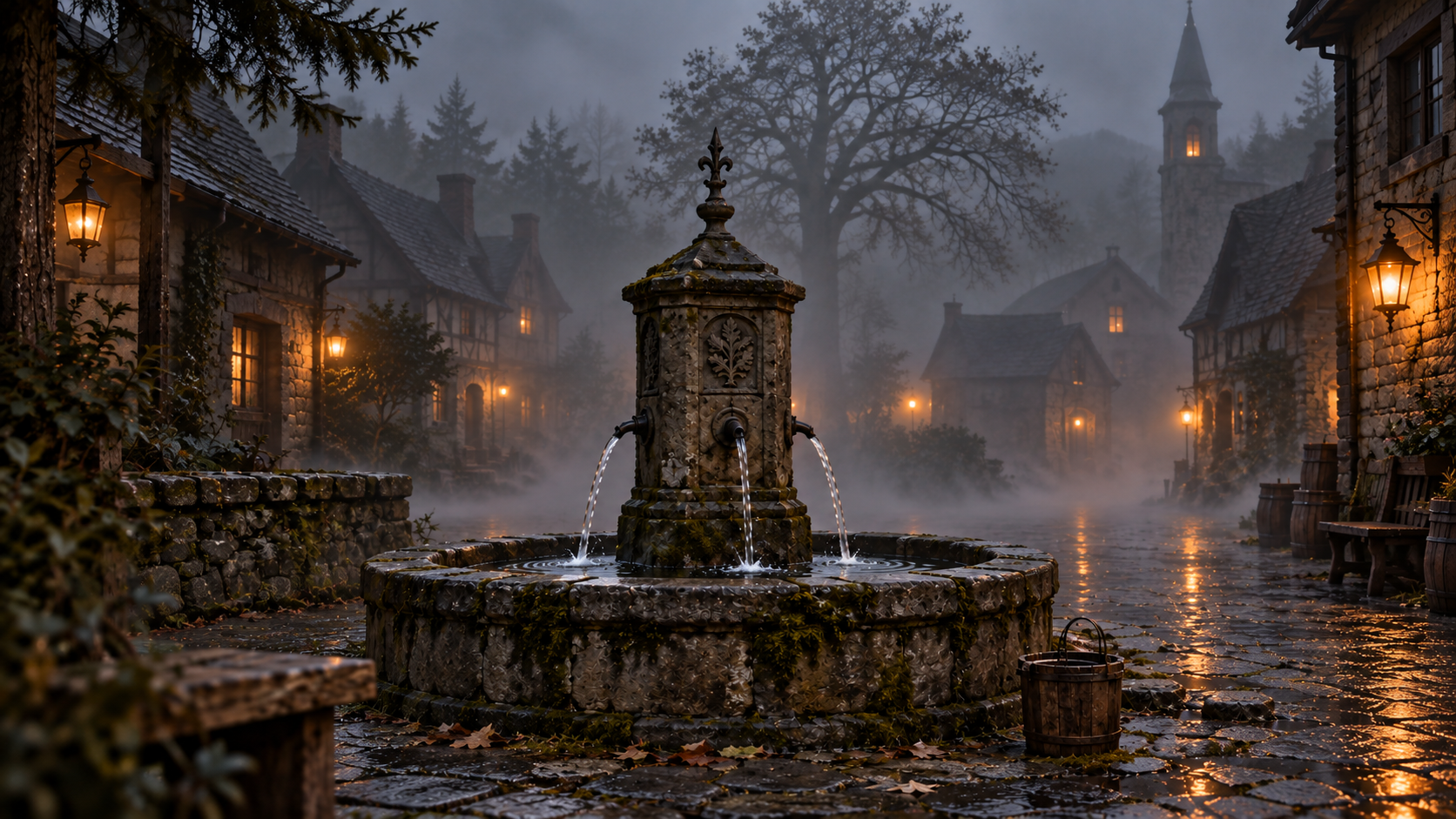
      The Deepwell - The villagers call it the Deepwell, though no one is entirely certain where its water comes from.

The fountain is older than the surrounding streets. Old maps show buildings changing, roads shifting, and even branches of the river wandering over the centuries—but the Deepwell is always marked in precisely the same place.

Its water is remarkably cold, clear, and clean. Even during floods, droughts, outbreaks of sickness, or strange disturbances in the valley's rivers, the Deepwell continues to flow at exactly the same rate.

There is no visible spring beneath it.

Years ago, workers attempted to repair a crack beneath the basin and discovered a narrow stone shaft descending directly below the fountain. They lowered nearly two hundred feet of rope into it without reaching water or bottom.

They stopped looking.

The Deepwell has since become part of everyday village life. Tavernkeepers fill barrels here. Herbalists insist its water keeps mixtures fresh longer. Travelers refill their skins before taking the Emberway into the forest. Children toss copper coins into the basin and make wishes, despite being repeatedly told not to.

There is one old superstition everyone knows:

Never take water from the Deepwell after midnight.

Ask why, and older villagers usually shrug.

"Water tastes different after midnight."

They will not elaborate.

More unsettling are the mornings when someone finds the fountain completely still.

No flowing water.

No dripping spouts.

Not even a ripple across the basin.

It never lasts more than a few minutes.

And whenever it happens, the Lamplighters quietly begin checking every lantern in the village.

Because according to an old saying:

“When the Deepwell holds its breath, something beneath the fog is listening.”

      EMBERMIST HOLLOW VILLAGE - Hidden deep within a narrow mountain valley, the village is a place of warm lanterns surrounded by seemingly endless gloom.

Sheer, pine-covered mountains rise on every side, their upper reaches frequently disappearing into cloud and fog. Waterfalls tumble from distant cliffs, feeding the network of cold mountain rivers and streams that wind directly through the settlement. Stone bridges connect neighborhoods divided by the water, while smaller wooden footbridges cross the narrow branches.

The village is beautiful.

But there is something undeniably strange about it.

A thick blanket of mist and low cloud settles over the valley for much of the year. Even during daylight, the sun is often little more than a pale glow somewhere above the mountains.

The village has adapted to living without reliable sunlight.

Lanterns are everywhere.

They hang from buildings, stand beside bridges, illuminate intersections, mark forest paths, and burn outside isolated homes. Their warm amber glow has become such an essential part of village life that the people barely notice them anymore.

Keeping those lights burning is the responsibility of Cornelia, Cornwalis, and the Lamplighter Guild.

To outsiders, the number of lanterns can seem excessive.

Villagers know better.

Around here, light means safety.

Most buildings are constructed in an old Tudor style of dark timber, rough stone, plaster, and steep slate roofs designed to withstand the mountain weather. Nothing is particularly grand. Buildings usually rise two stories, and even the wealthier homes retain the practical character of a settlement isolated deep within the mountains.

Cobblestone streets twist organically between homes rather than following any deliberate plan. Moss grows between the stones. Ivy climbs walls. Pine trees and enormous boulders have often been incorporated into neighborhoods rather than removed.

The village feels as though it was built around the valley rather than imposed upon it.

At its heart is the Central Plaza, where merchants gather with their carts and stalls. Shops, homes, guildhouses, and workshops surround the square, and nearby stands one of the village's strangest landmarks: The Astrolabe.

Its intricate rings slowly turn above the plaza, covered with strange markings whose original purpose few villagers understand. Once each year during the Lantern Festival, it releases a pulse of magic that drives the fog from the valley and reveals the stars overhead.

For many villagers, it is the only truly clear night sky they see all year.

Not far from the Astrolabe stands the Wrong Turn Tavern & Inn, the true social center of the village.

Its windows glow late into the night, and laughter can often be heard before the building itself emerges from the fog.

Everyone eventually passes through the Wrong Turn.

Farmers drink beside merchants. Rennin's deputies share tables with adventurers. Travelers bring news from outside the valley. Deals are made, arguments begin, romances flourish, and rumors spread with astonishing speed.

If the Central Plaza is the village's heart during the day, the Wrong Turn becomes its heart after dark.

Water is everywhere.

Heated by underground volcanic activity, the main river winds past the center of town, its banks lined with homes, workshops, docks, and warehouses. Smaller branches divide from it and wander through neighborhoods before eventually rejoining downstream.

Near the edge of town stands Miller's Folly, its enormous waterwheel turning relentlessly in the current.

Above the main river sits the Riverwatch, an old stone overlook where villagers gather beneath lanterns to watch the water and look across the rooftops toward the Astrolabe and the glowing windows of the Wrong Turn.

The village becomes quieter toward its edges.

Here stand places such as Stone and Root, Brynhild's welcoming home and herbal shop, and the Broken Compass, whose shelves contain nearly everything a traveler might reasonably need—and several things nobody remembers ordering.

Rennin maintains order from the Constable's Office, while Cornelia and Cornwalis operate from the deceptively ordinary headquarters of the Lamplighter Guild.

In the wealthier quarter stand larger homes behind low stone walls, including the ancestral manor belonging to Ilianna's family.

Then there is the Cold Forge.

Its doors remain closed.

Its windows remain dark.

The vegetation has slowly begun reclaiming the old weaponsmith's workshop.

Nobody works there anymore.

Sometimes people hear hammering anyway.

Eventually the cobblestones surrender to forest.

One road becomes the Emberway, disappearing beneath towering pines with lanterns marking its route through the fog.

Another path leads toward the Stillgarden, the village's old cemetery and mausoleum. Beneath the mausoleum lie ancient crypts and natural caverns extending much farther beneath the valley than most villagers realize.

And one path climbs.

Higher and higher into the mountains it winds until reaching the Meeting House, where the reclusive elven warrior-monks receive outsiders.

Villagers are permitted to travel that far.

No farther.

Beyond the Meeting House, the path continues upward toward the forbidden monastery hidden somewhere among the cliffs and fog.

For all its mysteries, the village isn't a grim place.

Quite the opposite.

People have learned to compensate for the darkness by making their homes warm, colorful, noisy, and communal.

Neighbors know one another. Shopkeepers remember customers. Doors remain open to friends. People gather around fireplaces and share meals because spending too much time alone in a place surrounded by fog and mountains doesn't appeal to anyone.

There are festivals, markets, music, gossip, arguments, romances, rivalries, and traditions stretching back generations.

People complain about Rennin.

Rennin complains about paperwork.

Everyone complains about the Burgomaster.

And Cornelia and Cornwalis somehow know about all of it.

At sunset, the village changes.

The mountains become enormous black silhouettes.

Fog rolls much thicker through the streets and across the rivers.

Doors close.

Shutters are drawn.

Then, the purpose of the commonplace lanterns become more apparent.

Across bridges.

Along streets.

Beside homes.

Through the Central Plaza.

Up the Emberway.

From the mountains above, the entire village looks like a constellation of tiny golden stars trapped beneath an ocean of fog.
      THE WRONG TURN - The Wrong Turn is the beating heart of the village.

Standing beside the main branch of the river near the Central Plaza, the large two-story Tudor tavern and inn is one of the first places newcomers notice and one of the last places still awake at night. Its dark timber frame, rough stone foundation, steep slate roofs, and tall chimneys give it the appearance of a building that has stood here for generations. A large wooden sign hangs beside the entrance:

THE WRONG TURN — TAVERN & INN

The name comes from an old local saying that anyone who found this isolated village must have taken a wrong turn somewhere.

At almost any hour, the Wrong Turn glows.

Lanterns hang beneath the eaves and beside the doors, while large ground-floor windows spill golden light across the wet cobblestones. Smoke curls constantly from the chimneys. On cold evenings, opening the front door releases a wave of warmth accompanied by the smells of woodsmoke, roasting meat, fresh bread, spilled ale, and pipe tobacco.

And then comes the noise.

Conversation. Laughter. Tankards striking tables. Chairs scraping floors. Someone arguing over cards. Someone else telling a story everyone has heard twenty times. Occasionally music rises above everything before being drowned out again by the crowd.

The Wrong Turn is rarely quiet.

Most of the ground floor is dominated by an enormous common room, built around a great stone hearth that burns almost continuously.

Long wooden tables encourage strangers to sit together, while smaller tables occupy the walls and windows. A broad, battered bar stretches across one side of the room, its shelves crowded with bottles, mugs, jars, and casks.

Nothing matches perfectly.

The chairs have been repaired dozens of times. Tables bear knife marks and initials. The floorboards creak. The stone around the hearth has been blackened by decades of fires.

It feels comfortable rather than shabby.

There are always familiar faces here. Merchants conduct business over drinks. Farmers stop after delivering goods. Lamplighters gather after their evening rounds. Rennin's deputies occasionally occupy a corner table. Adventurers attract curious glances until they've been around long enough to become part of the scenery.

Even Cornelia and Cornwalis appear with suspicious frequency.

The second floor is much quieter.

A broad staircase leads to a hallway containing a dozen modest guest rooms. Their small mullioned windows are the warm squares of light visible from the street at night.

The rooms aren't luxurious, but they're comfortable: heavy wooden beds, thick quilts, washbasins, wardrobes, small writing tables, and lanterns beside the beds. A few larger rooms overlook the river and command surprisingly beautiful views of the village.

From one side, guests can see the Central Plaza and Astrolabe through the fog.

From the other, they can fall asleep listening to the river.

Assuming the noise downstairs doesn't keep them awake.

The Wrong Turn serves a purpose far greater than providing food and beds.

It is effectively the village's communal living room.

Birthdays are celebrated here. Deals are struck here. Arguments begin here—and occasionally end outside. Travelers bring news from beyond the valley. Adventurers find work. Villagers gather when storms close the mountain roads.

When something frightening happens, people instinctively gravitate toward the Wrong Turn.

There is warmth.

There is food.

There are other people.

And there are always lanterns burning.

During the Lantern Festival, the tavern becomes almost impossibly crowded. Every room is occupied, tables spill into every available corner, musicians play until late into the night, and people stand shoulder-to-shoulder around the bar.

From its windows, the Astrolabe can be seen across the plaza.

And when its annual pulse drives away the fog and reveals the stars, practically everyone inside pours into the street at once.

There is an old custom at the Wrong Turn:

Nobody drinks alone unless they want to.

A stranger sitting by themselves long enough will eventually find another mug placed on their table and somebody pulling up a chair.

That, more than the ale or the rooms, explains why the Wrong Turn has endured.

Outside its windows lies a village of fog, secrets, dark forests, strange magic, and things moving beyond the lantern light.

But inside the Wrong Turn there is fire, laughter, food, friendship, and noise.

For a few hours, at least, the gloom stays outside.
      STONE AND ROOT - Inside, the gloom of the village seems to disappear.  The shop is comfortably cluttered with shelves of herbs, dried mushrooms, roots, teas, tinctures, salves, candles, and bundles of medicinal plants. Dried flowers and herbs hang from the ceiling beams, while little handwritten labels cover jars and ceramic pots. There is always something simmering over the hearth—a kettle of tea, a medicinal broth, or occasionally Brynhild's dinner. The air smells of cedar smoke, lavender, dried mint, damp earth, and fresh bread.

But Stone and Root is also Brynhild's home, and she makes little distinction between the two. Beyond the counter sits a large scarred wooden table surrounded by mismatched chairs. Friends know they don't need an invitation to sit down. Customers who arrive cold or frightened frequently discover that a cup of hot tea has appeared in their hands before they've even explained why they've come.

There are comfortable chairs near the hearth, blankets folded in a basket, books stacked wherever there is room, and an old kettle that seems permanently suspended over the fire. Brynhild keeps food in the cupboard specifically because she knows certain people will inevitably arrive hungry.

There is no formal closing time. If the viridian lantern outside the shop is burning, Brynhild is awake—and anyone she considers a friend is welcome.

Among the villagers, Stone and Root has quietly become neutral ground. Guards, thieves, adventurers, merchants, lamplighters, and ordinary villagers have all found themselves sitting around Brynhild's table at one time or another. Arguments have a peculiar tendency to become quieter once tea is poured.

Brynhild herself would never call the place a sanctuary.

But that's what it is.

Stone and Root is where people in the foggy village go when they need medicine, advice, warmth—or simply somewhere they know they'll be welcome.

“There’s one candle in Stone & Root that Brynhild never sells, never moves, and never lets go out. We’ve stopped asking why.”
— Cornelia & Cornwalis
      THE LAMPLIGHTER GUILD - The Lamplighter Guild Headquarters is surprisingly unremarkable for an organization that seems to know nearly everything happening in the village. It occupies a broad, comfortable two-story home on a quiet cobblestone lane, marked only by a small wooden sign bearing the image of a burning lantern. There are no grand banners or official proclamations. If you didn't know what you were looking for, you might mistake it for the home of a prosperous merchant.

One thing, however, immediately distinguishes it: the lanterns never go out.

Day or night, fog or storm, several lanterns burn outside the headquarters. Their warm amber light spills across the wet stones and pushes back the perpetual gloom. Inside, the place feels more like a crowded family home than a guildhall. A large hearth burns constantly, kettles simmer, boots dry beside the fire, and the long central table is usually buried beneath maps, repair ledgers, lamp oil receipts, half-eaten meals, mugs of tea—and scraps of paper containing information that probably shouldn't be there.

The guild is run by the halfling siblings Cornelia and Cornwalis, a cheerful, mischievous pair whose harmless appearance has fooled more than one newcomer. Officially, they oversee the village lanterns, organize nightly lighting routes, replace damaged lamps, maintain oil supplies, and ensure that no important street is ever surrendered completely to the fog.

Unofficially, they seem to know everyone's business.

Lamplighters go everywhere. They climb past bedroom windows, work behind taverns, wander empty streets after midnight, enter businesses before dawn, and hear conversations from people who forget that the little figure on the ladder nearby has ears. Every evening dozens of guild members leave headquarters carrying ladders, oil, tinderboxes, and replacement glass. Every morning they return with considerably more information than they left with.

Cornelia and Cornwalis insist this is coincidence.

Ask Cornelia about a secret meeting behind the Wrong Turn Tavern and she'll look genuinely surprised that you'd imagine she knew anything about it—while casually mentioning what time the participants left. Cornwalis might deny knowing who's sleeping with whom while reminding you that someone's husband unexpectedly returned home at half past midnight last Thursday.

Neither sibling considers this spying.

"We maintain lanterns."

That's usually where the explanation ends.

Despite their questionable respect for privacy, the Lamplighters are fiercely protective of the village. They understand better than most that the lanterns aren't merely decoration. Light means safety. When the fog thickens, something prowls the streets, or strange magic settles over the valley, the guild doubles its patrols without needing to be asked.

And when something truly dangerous is happening, Cornelia and Cornwalis somehow seem to appear nearby—usually carrying a ladder, an oil can, and an entirely plausible explanation for why they couldn't possibly know anything about it.

Among the villagers there's an old joke:

If you want everyone to know something, announce it in the tavern.

If you want Cornelia and Cornwalis to know something, whisper it somewhere you think you're alone.
      THE BROKEN COMPASS - The Broken Compass is the closest thing the foggy village has to a proper general store. Sitting along one of the busier cobblestone streets, the old two-story timber-and-stone building is perpetually surrounded by barrels, crates, sacks, bundles of rope, firewood, and the occasional merchant's cart waiting to be unloaded. A weathered wooden sign hangs over the entrance bearing a compass rose with its needle snapped neatly in two.

The name is an old village joke: once you've reached this place, a compass isn't going to help you much anyway.

Inside, the Broken Compass is wonderfully crowded. Shelves climb almost to the rafters, packed with everything from lantern oil and candles to blankets, cookware, nails, rope, fishing tackle, dried provisions, tools, inexpensive clothing, boots, parchment, ink, lamp glass, and whatever oddities have arrived with the latest merchant caravan. Narrow aisles wind between stacks of crates, and customers occasionally have to turn sideways to pass one another.

For adventurers, there's an especially interesting section near the back. Packs, bedrolls, climbing gear, torches, maps, ammunition, basic weapons, and other traveling equipment can usually be found there. Nothing particularly exotic—but almost everything practical.

The store also has a reputation for acquiring unusual things.

A box arriving from outside the valley might contain imported wine one week, strange Feywild mushrooms the next, and six pairs of military boots nobody remembers ordering the week after that. The proprietor rarely seems surprised.
      THE CONSTABLE'S OFFICE - The Constable’s Office stands along one of the village’s main cobblestone streets, a sturdy two-story building of dark timber and rough mountain stone. It isn't a fortress or barracks. It looks more like an old, respectable village home that gradually accumulated the responsibilities of keeping order. A simple wooden sign outside reads CONSTABLE, illuminated by a lantern that burns through the fog each night.

Inside, the building is warm, practical, and slightly overcrowded. The front room serves as the public office and watch room, with Rennin’s heavy wooden desk occupying one side and a long table for his deputies on the other. Maps of the village and surrounding valley cover the walls alongside patrol schedules, missing-person notices, warrants, and handwritten reports. A large notice board near the entrance is crowded with announcements and wanted posters.

Rennin's desk is organized in a way that only Rennin understands. There are neatly stacked official reports beside half-finished correspondence, maps covered with annotations, evidence bags, sealing wax, and a perpetually cooling mug of something he forgot he was drinking. His green cloak usually hangs from a peg behind the desk when he's inside.

A small armory occupies a locked room toward the rear, containing shields, crossbows, spears, manacles, lanterns, and equipment for the deputies. Beside it are two modest holding cells—stone-walled, iron-barred, and deliberately uncomfortable without being cruel. Most occupants are drunks waiting to sober up, petty thieves, or villagers who made exceptionally poor decisions at the Wrong Turn Tavern.

Upstairs are Rennin's private office, records storage, and a small room where an exhausted deputy can sleep between shifts. Rennin keeps older case files here, including several locked cabinets containing investigations that were never satisfactorily resolved.

The building has a back entrance opening onto a small enclosed yard, where the deputies practice, store equipment, and occasionally bring prisoners inside without marching them through the front office.

Despite being the center of village law, the place doesn't feel oppressive. Villagers wander in to report missing livestock, settle arguments, complain about noise, ask for help, or simply tell Rennin something they think he ought to know. Children occasionally appear with reports of suspicious strangers that turn out to be unusually shaped tree stumps.

Rennin takes all of them seriously.

What gives the office its character is Rennin himself. For all the authority represented by the weapons, cells, and official notices, he doesn't rule the village from behind his desk. He spends much of his time walking its streets, talking to people, and knowing his community personally.

There is, however, one feature of the office that visitors eventually notice.

Beside Rennin's desk hangs an enormous map of the village covered with colored pins, strings, dates, names, and tiny handwritten notes. Wererat activity, unexplained disappearances, strange deliveries, Fey incidents, suspicious newcomers, and dozens of seemingly unrelated occurrences have all found their way onto it.

Rennin calls it his "unfinished business."

Cornelia and Cornwalis call it "the board where Rennin keeps discovering things we already knew."
      THE CENTRAL PLAZA - The Central Plaza is the beating heart of the foggy village—a broad, irregular square of ancient cobblestone where nearly every road eventually seems to lead. Surrounded by timber-framed shops, homes, guildhouses, and taverns, it is rarely empty. Even beneath the perpetual gloom, the plaza feels alive.

Dozens of iron lanterns stand around its perimeter and hang from neighboring buildings, their warm amber glow reflecting from cobblestones perpetually darkened by mist. The Lamplighter Guild takes particular pride in the plaza; not a single lantern here is permitted to go dark. Cornelia and Cornwalis would probably consider such an occurrence a personal insult.

During the day, the plaza becomes the village's principal marketplace. Wooden carts and temporary stalls appear in seemingly random arrangements, selling vegetables, mountain herbs, bread, smoked meats, tools, pottery, cloth, firewood, and goods brought into the valley by traveling merchants. Farmers argue over prices, children weave between carts, dogs investigate unattended baskets, and merchants loudly insist that whatever they're selling is considerably rarer than it actually is.

At night, most of the carts disappear and the plaza changes character. The crowds thin, doors close, and fog begins creeping between the buildings. Lanterns become islands of amber light surrounded by gray. Footsteps echo strangely across the wet stones, and someone crossing the plaza can sometimes hear another person walking long before they emerge from the mist.

A massive old pine tree grows near one side of the square. Nobody remembers it being planted. A circular stone bench surrounds its trunk, making it a favorite meeting place for villagers. During festivals its branches are decorated with lanterns, ribbons, and small charms.

A public notice board stands near the main road, perpetually covered in proclamations, advertisements, missing-animal notices, job postings, handwritten complaints, and pieces of paper Rennin wishes people would stop putting there.

There is also a small raised stone platform along one edge of the plaza. Most days it serves as somewhere for merchants, musicians, and village criers to stand. On important occasions, the Burgomaster uses it to address the village. During the Lantern Festival it becomes a stage for performers, speeches, drinking contests, and whatever questionable entertainment Cornelia and Cornwalis have arranged that year.

The plaza is particularly spectacular during the Lantern Festival. Market stalls remain open late, musicians play in the streets, food and drink flow freely, and hundreds of lanterns illuminate the surrounding buildings. When the Astrolabe releases its yearly pulse and the fog briefly retreats, the entire village gathers here to look upward at a sky many of them rarely see.

More than anything, the Central Plaza is where village life becomes public.

News is announced here.

Arguments happen here.

Adventurers are noticed here.

Strangers are remembered here.

And if something extraordinary happens anywhere in the village, it usually isn't long before someone runs into the plaza shouting about it.

Which means Cornelia and Cornwalis generally knew about it five minutes earlier.
      VAILMERE MANNOR, BURGOMASTER RESIDENCE - The home of the Burgomaster and his reclusive elven wife stands in one of the village’s wealthier quarters, removed from the crowded shops and workshops of the central streets. It is an impressive three-story manor of pale stone, dark timber, and steep slate roofs.  Even beneath the village’s perpetual fog, the house manages to look dignified—and perhaps a little too pleased with itself.

The Burgomaster would call it modest.

Nobody else does.

Unlike many village homes that seem to have grown organically over generations, the residence is intentional in its imposing nature, orderly, and meticulously maintained. Ivy is permitted to grow on the walls, but only where it looks attractive. Hedges are trimmed. Brass fittings are polished. Lanterns flank the front entrance, and the cobblestone path is kept suspiciously free of mud, weeds, and moss.

Inside, the house reflects the personalities of its owners.

The Burgomaster favors heavy furniture, impressive portraits, trophies, maps, expensive rugs, and objects intended to remind visitors that they are speaking with an important man. His study contains an enormous desk positioned so guests must approach it, shelves filled with official records, bottles of excellent brandy, and a large portrait of himself that is considerably more heroic than anyone remembers him looking.

His wife has brought an entirely different refinement to the house. Her rooms possess the unmistakable elegance of old elven nobility—delicate furniture, silverwork, ancient books, fine porcelain, pale fabrics, carefully cultivated flowers, and pieces of elven artwork that are probably worth more than several neighboring houses combined.

The result is an odd but beautiful marriage of blustering human wealth and restrained elven aristocracy.

The main floor contains a formal receiving room, dining hall, library, kitchen, and the Burgomaster’s office. A large hearth keeps the central sitting room warm, although guests quickly discover that there is a considerable difference between being received here and being welcomed.

Upstairs are the couple's private chambers and several immaculate guest rooms. His wife's chambers overlook the gardens and contain a small private sitting room where she receives few people.

Behind the residence is a walled garden, unusually lush despite the village's limited sunlight. Lanterns hang from small iron posts along its paths, illuminating sculpted shrubs, mountain flowers, benches, and a small stone fountain. His wife takes considerably more interest in the garden than her husband does.

The residence is also a place where much of the village's unofficial politics happens. Wealthy merchants come for dinner. Guild leaders arrive through the front door. Petitioners wait nervously in the receiving room. Rennin occasionally appears carrying some unpleasant problem the Burgomaster would rather not hear about.

And Cornelia and Cornwalis somehow know what was discussed before breakfast the following morning.

The Burgomaster is convinced someone on his household staff is informing them.

His wife suspects otherwise.

She once noticed a Lamplighter repairing the lantern outside her bedroom window at eleven o'clock at night.

It didn't require repairing.
      STILLGARDEN CEMETERY - The village graveyard lies near the outer edge of town where the cobblestones give way to dark pines, moss-covered boulders, and rising mountain slopes. An old wrought-iron gate marks the entrance, flanked by two stone pillars upon which lanterns burn every night. Beyond them, a narrow path winds through weathered headstones before ending at the old stone mausoleum.

The graveyard is ancient—far older than much of the village surrounding it.

Generations of villagers rest here. Some graves are marked by elaborate carved stones, others by little more than worn slabs whose names have disappeared beneath centuries of rain and moss. Families traditionally leave small lanterns beside the graves of loved ones, so on certain nights dozens of tiny flames flicker throughout the cemetery, appearing and disappearing as the fog moves between them.

It is a beautiful place during the day.

At night, considerably less so.

The fog seems particularly reluctant to leave the graveyard. It pools between the stones and curls around ankles as visitors walk the paths. Sound behaves strangely here as well. The village might only be a short walk away, yet beyond the iron gates its taverns, mills, and streets seem impossibly distant.

At the far end stands the mausoleum.

Built from enormous blocks of dark gray stone, the structure is partially covered in ivy and mountain moss. Broad steps lead between weathered columns to a pair of heavy doors. The carvings above them have been worn nearly smooth, though careful examination reveals symbols that don't correspond to any family currently living in the village.

Nobody seems entirely certain whose mausoleum it originally was.

Inside, the air is cold and smells of stone, dust, old incense, and damp earth. Stone alcoves line the walls, containing the remains of several prominent villagers from generations past. Candle niches have been carved into the walls, and villagers still occasionally leave flowers, coins, or small personal objects upon the tombs.

But the mausoleum has another purpose.

A concealed stairway descends beneath it into the older crypts below the graveyard. These chambers predate the mausoleum itself. Rough stone corridors lead through burial chambers, collapsed passages, and forgotten tombs before eventually reaching the natural caverns beneath the village—the same strange underground world of subterranean water, phosphorescent moss, and glowing mushrooms that the party has already encountered.

Most villagers know there are crypts beneath the mausoleum.

Very few understand how far down they actually go.

Rennin keeps the cemetery gate watched whenever anything unusual happens in the village, and even the Lamplighters make certain the lanterns along its perimeter remain especially well maintained.

Cornelia and Cornwalis have only one piece of advice concerning the graveyard:

If you see a lantern moving among the graves after midnight, make sure someone is carrying it.
      ERYNDRAEL MONASTERY AND THE MEETING HOUSE - High above the village, where the last cobblestone paths disappear beneath pine needles and the mountain becomes steep and unforgiving, stands the Eryndrael Monastery—an ancient sanctuary inhabited by an isolated order of elven warrior-monks.

From the village below, very little of the monastery can actually be seen. Occasionally the fog parts enough to reveal dark roofs, narrow towers, or the faint glow of lanterns impossibly high among the cliffs. A winding stone stairway climbs toward it through enormous pines and moss-covered boulders before disappearing completely into the mist.

The monks have lived upon the mountain for longer than anyone in the village can reliably remember. They rarely come down except for supplies, important ceremonies, or matters they consider threatening to the valley. They are courteous when encountered, but distant and intensely private.

There is one rule every villager knows:

You may climb as far as the Meeting House. No farther.

The Meeting House

About halfway up the mountain stands a timber-and-stone building known simply as the Meeting House.

It marks the boundary between the village and the monks.

The building is deliberately welcoming: a broad hearth, simple wooden tables, benches, a kettle perpetually kept warm, and several lanterns glowing beneath its covered porch. Villagers seeking the monks come here and ring a large bronze bell suspended beside the entrance.

Then they wait.

Eventually, one or more monks descend from the fog.

Trade takes place here. Disputes are discussed here. Rennin occasionally meets representatives of the order here. The sick may be brought here when someone believes the monks possess knowledge that Stone and Root cannot provide.

But the monks never invite villagers beyond it.

Behind the Meeting House stands a stone gateway without a gate. Beyond it, the path continues upward through the forest.

A simple inscription has been carved into the stone:

BEYOND THIS STONE, YOU WALK UNINVITED.

There are no guards.

There don't need to be.

Beyond the Boundary

The path above the Meeting House becomes increasingly ancient. Cobblestones give way to enormous weathered steps cut directly into the mountain. Small stone lanterns appear along the trail, burning with a faint blue-white flame that never seems affected by wind or rain.

Eventually the forest opens onto the monastery itself.

The Veiled Summit is not luxurious. It is a sprawling collection of ancient stone halls, wooden galleries, meditation chambers, courtyards, training grounds, shrines, and covered walkways constructed against the mountainside. Some buildings are partially carved directly into the rock.

There are no defensive walls.

That fact becomes considerably more intimidating once someone understands who lives there.

The elves train constantly.

At dawn they meditate.

Afterward comes weapons practice—quarterstaffs, spears, swords, bows, and unarmed combat. Their movements are extraordinarily disciplined and almost unnaturally synchronized. Some of the eldest monks have trained here for centuries.

Villagers occasionally hear distant bells or the rhythmic crack of wooden training weapons echoing down the mountain.

And Cornelia and Cornwalis—who normally have an irritating amount of information about everything—become unusually evasive whenever anyone asks what lies beyond the Meeting House.

Cornelia once offered only:

“Some doors are locked because somebody wants to keep you out.”

Cornwalis quietly added:

“And some are locked because somebody wants to keep something else in.”
      THE RIVERWATCH - Perched on a natural rise above the main branch of the river, the Riverwatch is one of the finest—and most secluded—places from which to look across the heart of the village. It isn't really a building at all, but an old stone overlook and gathering place, reached by a narrow cobblestone path climbing between pines and moss-covered boulders.

A broad semicircular terrace of weathered stone extends toward the edge of the hillside. A waist-high stone wall follows its perimeter, worn smooth in places by generations of villagers leaning against it. Several heavy wooden benches sit beneath the pines, and a small covered shelter provides protection from the seemingly endless drizzle.

From here, the village spreads out below.

The main river dominates the view, winding between buildings and disappearing beneath old stone bridges. On cold evenings, pale mist rises from its warmer waters and mingles with the fog drifting through the streets.

Directly across the river lies the center of the village. Through breaks in the mist, the strange silhouette of the Astrolabe can be seen rising above its plaza, its metal rings occasionally catching lantern light as they slowly turn.

Nearby stands the welcoming bulk of the Wrong Turn Tavern, its glowing windows among the brightest things visible from the overlook. On particularly foggy nights, the village itself can almost disappear, leaving only those windows and scattered street lanterns suspended like distant stars in the gray.

A handful of iron lanterns line the Riverwatch's stone wall. The Lamplighters maintain them obsessively, giving the terrace a warm amber glow without spoiling the view.

The Riverwatch has become an unofficial meeting place for people who want to talk away from the ears of the Central Plaza. Friends gather here with bottles from the tavern. Lovers meet beneath the pines. Rennin occasionally conducts conversations here when he doesn't want them taking place in his office. Travelers come simply to sit and watch the river.

There is even an old stone table near the center of the terrace, making the place useful for spreading out maps, sharing food, or holding a quiet meeting.

At night, when the fog is thickest, the Riverwatch becomes extraordinarily peaceful. The rush of the river rises from below, lanterns shimmer through the mist, and somewhere in the distance comes the muffled noise of the Wrong Turn Tavern.

And above it all, whenever the fog shifts just enough, the Astrolabe can be seen slowly turning.


The irony, of course, is that villagers consider the Riverwatch an excellent place for private conversations.

Cornelia and Cornwalis have never corrected them.
      MILLER'S FOLLY - Miller’s Folly is an old water-powered grain mill standing near the edge of the village where one of the mountain rivers narrows between great moss-covered boulders. Built from heavy gray stone and dark, weathered timber, the mill looks as though it has been clinging stubbornly to the riverbank for centuries. Pines crowd close around it, and on most mornings the building is half-hidden behind river mist and the village’s ever-present fog.

The mill takes its name from Edmund Miller, the stubborn craftsman who built it generations ago.

Everyone warned Miller that the river was too unpredictable. Spring runoff would destroy it. Winter ice would tear away the wheel. The foundation would sink. The river would change course.

Miller built it anyway.

When the mill survived its first winter, villagers started calling it “Miller’s Folly” as a joke.

When it survived the next hundred winters, the name became one of reluctant admiration.

The great wooden waterwheel still turns, slowly and relentlessly, groaning beneath the force of the dark mountain water. Inside, enormous wooden gears rotate overhead while belts, shafts, and millstones fill the building with a constant rhythmic clack... groan... thump... clack. Flour dust hangs in the air, covering beams, barrels, sacks, and occasionally the miller himself in a thin coating of white.

The ground floor is a working maze of grain sacks, scales, barrels, wooden chutes, tools, and enormous millstones. A narrow staircase leads to the upper floor where grain is stored before being fed into the machinery. Beneath the mill is an older stone foundation containing maintenance passages that allow access to the wheelworks and the river channel.

Few villagers enjoy going down there.

The sound of the river becomes deafening beneath the building, lantern flames behave strangely in the damp air, and there are sections of the foundation that clearly predate Edmund Miller’s mill.

Outside, a narrow stone bridge crosses the river nearby. A muddy loading yard provides room for wagons bringing grain from farms outside the village, while a small covered platform allows sacks of flour to be loaded without being soaked by the seemingly perpetual drizzle.

Despite its lonely appearance, Miller’s Folly is enormously important. Much of the village's grain passes through its doors. Bakers depend upon it, farmers gather there to trade news, and carts regularly travel between the mill and the Central Plaza.

The Lamplighters maintain three lanterns along the road and another beside the mill door. All four are kept burning throughout the night.

There used to be five.

The fifth stood beside the river below the waterwheel.

Every time the Lamplighters replaced it, something extinguished it before morning.

Eventually Cornelia and Cornwalis stopped replacing it.

When asked why, Cornwalis simply says:

“There's fighting the gloom, and then there's irritating it.”
      THE EMBERWAY - The Emberway is the main route leading away from the village and into the dense evergreen forest surrounding the valley. It begins as a proper cobblestone lane near the outer homes, but within a few hundred yards the stones become uneven and moss-covered, eventually narrowing into a winding forest path beneath towering pines and firs.

The road takes its name from the lanterns that mark its course.

Simple iron lanterns hang from weathered wooden posts at regular intervals. Their warm amber flames resemble tiny embers floating in the darkness, each positioned so that a traveler standing beneath one can usually make out the faint glow of the next through the fog.

The Lamplighter Guild maintains every one of them.

The forest surrounding the Emberway is remarkably beautiful. Ancient trees rise into a canopy almost completely lost in mist. Ferns, mushrooms, moss-covered boulders, fallen logs, and mountain flowers crowd the forest floor. Small streams occasionally cross beneath old stone culverts or simple wooden footbridges.

But the farther one travels from the village, the quieter the forest becomes.

The sounds of taverns, mills, flowing rivers, and village life slowly disappear. Soon there is only the crunch of boots against the path, the whisper of wind through pine needles, and the occasional groaning of enormous trees somewhere beyond the lantern light.

Fog gathers heavily between the trunks.

Sometimes it becomes so thick that the forest beyond the path simply seems to cease to exist.

That is why the lanterns are more than conveniences.

Each little flame represents a boundary between the familiar and the unknown—a reminder that the village still reaches this far.

Travelers have an old custom when walking the Emberway after dark. Upon reaching each lantern, they briefly place a hand against its wooden post before continuing onward.

Nobody remembers exactly why.

Most villagers do it anyway.

There are stories, of course.

Travelers occasionally claim to have seen another lantern moving through the forest, traveling parallel to the Emberway where no trail exists. Others speak of hearing footsteps among the trees, following them from one pool of light to the next and stopping whenever they stop.

Cornelia and Cornwalis dismiss most of these stories with their usual smiles.

What they don't dismiss is an extinguished lantern.

If a single lantern along the Emberway goes dark, the Lamplighters replace it before the following night.

If two consecutive lanterns are found extinguished, Rennin is informed.

And if three lanterns go dark at once, the Emberway is closed.

No argument.

No exceptions.

Nobody in the village seems particularly eager to explain why.

So anyone traveling the Emberway after sunset learns the same piece of advice:

Stay on the Emberway. Keep the next lantern in sight.

And if you see a light moving among the trees, don't follow it.
      THE COLD FORGE - Near the older edge of the village stands a shuttered weaponsmith and armory known simply as The Cold Forge. Once one of the busiest workshops in the valley, it has been abandoned for years.

The building is a broad, two-story structure of heavy stone and blackened timber, built to withstand the heat and sparks of a working forge. A squat stone chimney rises from its moss-covered roof, but no smoke has emerged from it in a very long time. Ivy has climbed across much of the masonry, ferns grow between the cobblestones, and weeds have overtaken what was once the loading yard.

Unlike a ruin, however, The Cold Forge is remarkably intact.

Its windows aren't broken. Its roof hasn't collapsed. The enormous iron-bound front doors remain securely closed. Through the dusty glass, one can still make out weapon racks, armor stands, workbenches, and tools hanging exactly where their owner left them.

That's what makes the place unsettling.

It doesn't look destroyed.

It looks abandoned in the middle of a working day.

Its last master was Haldric Voss, one of the finest weaponsmiths the village had ever known. Haldric wasn't a wizard, but he possessed an uncanny talent for metalwork. A blade leaving his forge held an edge for years, and armor bearing his maker's mark was sought after throughout the valley.

Then Haldric received an unusual commission.

A traveler brought him several ingots of strange black metal recovered somewhere beneath the mountains. The stranger wanted the metal forged into a sword and offered enough gold that Haldric couldn't refuse.

The metal behaved unlike anything he'd worked before.

It required tremendous heat but never seemed to glow properly. Sparks from it burned a strange pale color. Haldric began working at night, becoming increasingly obsessed with finishing the weapon. Neighbors remembered hearing his hammer long after midnight.

Clang.

Clang.

Clang.

Night after night.

Then, one morning, it stopped.

When Haldric failed to open the shop, Rennin's predecessor eventually entered.

The forge was cold.

Haldric was gone.

There was no blood. No sign of violence. No forced entry. His coat still hung beside the door. His breakfast remained on the table upstairs.

And sitting upon the anvil was the unfinished black blade.

Nobody ever found Haldric Voss.

The Burgomaster ordered the forge closed. The strange weapon was supposedly removed and locked away, and eventually the building passed into village ownership. Several attempts have been made to sell it, but every prospective buyer has changed their mind.

Because sooner or later, anyone spending enough time near the building notices the same thing.

On particularly foggy nights, sometime after midnight, the forge begins working again.

There is no fire in the chimney.

There is no light behind the windows.

But from inside comes the unmistakable sound of a smith's hammer striking an anvil.

Clang.

A long silence.

Clang.

Another silence.

Clang.

The Lamplighter Guild still maintains the lantern outside The Cold Forge.

Cornelia and Cornwalis have given their people very specific instructions:

Light the lantern. Don't look through the windows. And if you hear hammering, don't knock.
      WICK & WAYWARD - Wick & Wayward sits in one of the older, less respectable corners of the village, down a narrow cobblestone lane where the buildings crowd closer together and the lanterns never seem quite as bright.

From the street, it appears to be an eccentric little shop specializing in candles, candlesticks, lanterns, lamp oil, incense, and odd pieces of household metalwork. Its windows are crowded with brass candleholders, iron lanterns, bundles of colored candles, little oil lamps, and tarnished silver pieces whose origins are sometimes difficult to explain.

The name is painted discreetly above the entrance:

WICK & WAYWARD

Inside, the shop is warm, cramped, and pleasantly chaotic. Hundreds of candles illuminate shelves overflowing with merchandise. Wax has accumulated in colorful layers upon old tables and counters. Bundles of herbs and incense hang from the rafters, filling the air with scents of beeswax, cedar, cinnamon, smoke, and something faintly exotic.

The proprietor will happily sell you a candle.

They'll also buy things.

No questions asked.

A silver goblet you inherited from your grandmother? Certainly.

An expensive necklace you inexplicably found in an alley?

Also certainly.

A jeweled dagger bearing the crest of a noble family that reported a remarkably similar dagger stolen three days earlier?

The proprietor might pause.

Then reach beneath the counter for the better scales.

Everyone knows Wick & Wayward deals in secondhand goods.

Most villagers simply choose not to ask how secondhand.

Rennin has searched the place more than once.

He's never found anything.

The Guild Beneath the Wick

What almost nobody knows is that Wick & Wayward is merely the front door to something considerably larger.

Not literally, of course.

That would be far too obvious.

The entrance to the village's Thieves Guild isn't actually inside the shop. Instead, Wick & Wayward serves as a marker and screening point. Someone who knows the proper phrases can leave a message, arrange a meeting, fence stolen property, or request the services of someone who specializes in problems respectable businesses don't handle.

The actual guildhall lies nearby beneath the oldest section of the neighborhood.

A twisting network of forgotten cellars, storage tunnels, old drainage passages, and chambers carved into the stone beneath the streets has been quietly connected over generations. Somewhere within that maze is a concealed entrance leading into what guild members simply call: The Underwick.

The contrast with Wick & Wayward is immediate.

The Underwick is surprisingly comfortable and lavish.

Thick rugs cover old stone floors. Lanterns hang from timber beams. Maps cover the walls. There are couches, gambling tables, a small bar, private booths, training rooms, storerooms, and numerous little alcoves where conversations can occur without attracting attention.

And everywhere there are doors.

Some lead somewhere.

Some don't.

A few appear to lead somewhere but really don't.

And at least one doesn't appear to be a door at all.

The guild deliberately cultivates this confusion.

Members know the routes.

Visitors don't.

At the center of it all is Lady Tenebrae.

The middle-aged tiefling rogue rarely conducts business from behind a desk. She prefers an elegant chair near the hearth, a glass of wine within reach, surrounded by people who appear to be relaxing while quietly listening to everything happening around them.

Tenebrae doesn't behave like a criminal hiding beneath the village.

She behaves like a noblewoman receiving guests.

Because, in her mind, that's exactly what she is.

The Thieves Guild under Tenebrae isn't simply a collection of burglars. It is a network of thieves, smugglers, fences, informants, spies, counterfeiters, lockbreakers, gamblers, and people who specialize in obtaining things other people would prefer remain unobtainable.

Violence happens.

But Tenebrae considers unnecessary violence terribly unprofessional.

Stealing a nobleman's jewels without waking him demonstrates skill.

Stealing his jewels and murdering him demonstrates that you lack imagination.

The guild has an unusual relationship with the village.

Tenebrae permits theft.

She permits smuggling.

She permits blackmail under circumstances she finds sufficiently entertaining.

But certain activities are forbidden.

No trafficking. No harming children. No robbing Stone and Root. And nothing that deliberately threatens the survival of the village.

Breaking those rules doesn't bring Rennin.

It brings Tenebrae.

Most offenders would prefer Rennin.

There is even an unspoken understanding between the guild and the Constable's Office. Rennin knows organized crime exists within his village. Tenebrae knows Rennin knows.

Occasionally criminals disappear before Rennin can arrest them.

Occasionally information mysteriously appears on Rennin's desk.

Neither side acknowledges the arrangement.

Someone wishing to contact the Thieves Guild enters Wick & Wayward and asks:

“Do you have anything that burns without giving light?”

The shopkeeper responds:

“Only for those comfortable walking in the dark.”

If the visitor knows the proper response, arrangements are made.

They aren't immediately taken to the guildhall.

Instead, sometime later, they receive a black candle tied with a dark purple thread.

On the bottom is scratched a location and a time.

Go there alone.

Bring the candle.

Wait.

Someone will find you.

And that's the real secret of Wick & Wayward.

Everyone assumes the Thieves Guild is hidden somewhere beneath the shop.

It isn't.

Tenebrae encourages that rumor because it means anyone trying to find her spends their time watching the wrong building.

Cornelia and Cornwalis, naturally, know exactly where the real entrance is.

They've never told Rennin.

When he once asked Cornwalis directly, the halfling looked genuinely offended.

“Constable, we're Lamplighters. We don't go sneaking around dark tunnels.”

Cornelia waited until Rennin walked away.

Then added:

“That's why we bring lanterns.”
      THE ELSEWHERE OAK - No one remembers planting the Elsewhere Oak.

It stands alone in a small cobblestone square near the heart of the village—an enormous, ancient oak surrounded by mountain pines that should have choked it out centuries ago. Oaks do not grow naturally this high in the valley, yet the tree is larger and seemingly older than anything in the surrounding forest.

The oldest village records already mention it simply as “the old tree.” Even then, the writers spoke of it as something ancient.

The tree never seems affected by the valley’s strange climate. Frost does not kill its leaves. Heavy snow rarely settles on its branches. Its roots have lifted stones and cracked foundations nearby, yet no one has ever seen a root exposed beneath the tree itself.

There are other peculiarities.

Birds will perch in its branches, but never build nests there. Dogs sometimes stop at the edge of the square and refuse to approach. During heavy fog, villagers occasionally swear they can see shapes standing beneath the tree—only to find the square empty when they draw closer.

Carving into the bark is considered extraordinarily bad luck. Not because of any law or religious belief.

People simply don't do it.

Once, many years ago, the village council ordered one of its great limbs removed after it threatened the roof of a nearby home. Three woodsmen arrived that morning.

By sunset, the limb remained.

None of the three would ever explain what happened.

Perhaps strangest of all is an old village custom. When someone leaves the valley on a long journey, they touch the trunk of the Elsewhere Oak before departing.

When they return, they touch it again.

No one remembers how the tradition began.

And occasionally, after a violent storm or an especially heavy night of fog, something can be found resting among the roots—a strange coin, an unfamiliar flower, a child's wooden toy, a rusted key.

Things that no one in the village recognizes.

The villagers collect none of them.

By the following morning, they are always gone.
      The Deepwell - The villagers call it the Deepwell, though no one is entirely certain where its water comes from.

The fountain is older than the surrounding streets. Old maps show buildings changing, roads shifting, and even branches of the river wandering over the centuries—but the Deepwell is always marked in precisely the same place.

Its water is remarkably cold, clear, and clean. Even during floods, droughts, outbreaks of sickness, or strange disturbances in the valley's rivers, the Deepwell continues to flow at exactly the same rate.

There is no visible spring beneath it.

Years ago, workers attempted to repair a crack beneath the basin and discovered a narrow stone shaft descending directly below the fountain. They lowered nearly two hundred feet of rope into it without reaching water or bottom.

They stopped looking.

The Deepwell has since become part of everyday village life. Tavernkeepers fill barrels here. Herbalists insist its water keeps mixtures fresh longer. Travelers refill their skins before taking the Emberway into the forest. Children toss copper coins into the basin and make wishes, despite being repeatedly told not to.

There is one old superstition everyone knows:

Never take water from the Deepwell after midnight.

Ask why, and older villagers usually shrug.

"Water tastes different after midnight."

They will not elaborate.

More unsettling are the mornings when someone finds the fountain completely still.

No flowing water.

No dripping spouts.

Not even a ripple across the basin.

It never lasts more than a few minutes.

And whenever it happens, the Lamplighters quietly begin checking every lantern in the village.

Because according to an old saying:

“When the Deepwell holds its breath, something beneath the fog is listening.”

      • Home
      • ABOUT
      • Player Characters
      • NPCs of Embermist Hollow
      • Gallery
      Copyright © 2026 All rights reserved - The Fuzzy Dice
      Powered By SITE123 - How to create a website